


DSD vs PCM
DSD vs PCM
Most music listeners have a vague idea of what the technical specifications of your streaming service or CDs mean, and many have also heard the acronym “PCM” - but perhaps they also know DSD, and wonder if this format could be relevant for you, maybe even better?
Let's have a look.
The overview: what's in it?
PCM (Pulse Code Modulation):
- Audio CD format and used by lossless streaming services
- Resolution: 16 bit/ 44.1 kHz
DSD (Direct Stream Digital):
- Format of the Super Audio CD (SACD)
- Resolution: 1 bit/ 2822.4 kHz (2.8 MHz)
The principle
Audio CDs are sampled “often enough”, i.e. 44,100 times per second - this means that a DA converter can recognize frequencies up to 22,050Hz without any doubt, and are stored at this interval with a depth of 16 bits, which contain the exact volume information.
The SA-CD samples 2.8 million times per second. The SA-CD samples so often because the information does not contain exact information about the volume, but only relative information: a value of 0 means we are going down a little, a value of 1 means we are going up a little.
To reproduce a rapid change in volume, such as a single drum hit on the drums, the signal must be sampled very often in order to capture it correctly.
The given resolution supports a frequency range of up to 50kHz, compared to the 22.05kHz of Audio CD.
Audio CD, although called lossless, is absolutely a consumer format: Sony, for example, exclusively uses DSD as the archive format in their productions.
Why is this relevant?
The frequency range that these two formats can reach is not necessarily relevant for the human ear, but for the electronics behind them. There are converters that can only handle PCM - there are converters that can also handle DSD, and there are converters exclusively for DSD.
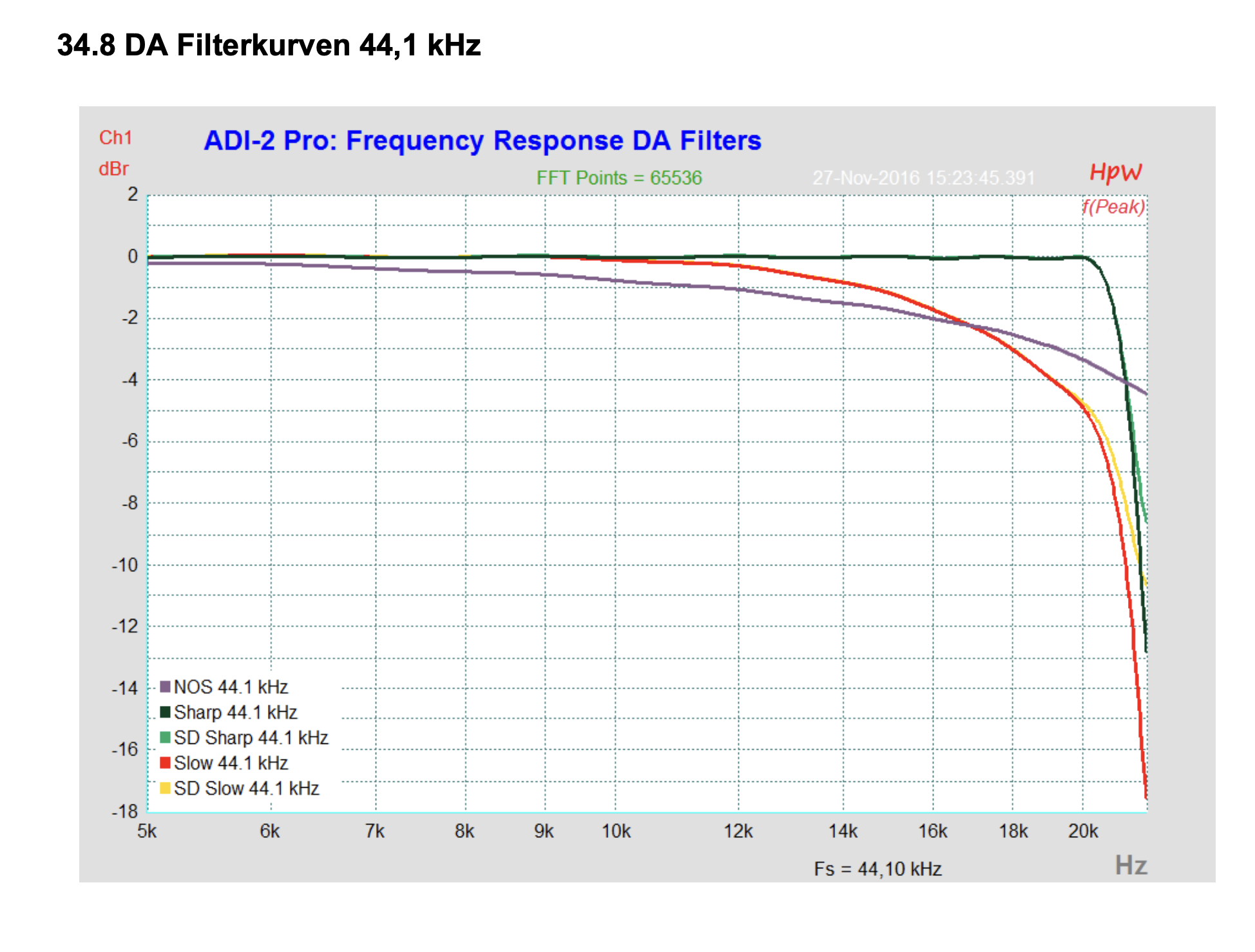
Practical example: RME Adi-2 Pro
This converter can process PCM and DSD and offers various filter options:
Personal impression
I myself have compared CD and SACD (and vinyl) of the same albums in extended listening sessions, and find that the SACD sounded much more like vinyl than CD.
This is meant to be positive, because you could feel the bass of the record - the bass of the CD was only perceived as a deep sine tone, and everything else was just as accurate, but flat.
The filter design for DSD is much simpler than that for PCM, which explains the impression that it is probably the more “analog” format.
Conclusion
This is just a brief introduction to the topic, in case you were ever curious about the format - to summarize:
- Unfortunately, DSD is rare, not all music is published in this format and not every DAC can handle it. If you still want to listen in DSD format, a PC setup is a must.
- PCM is a consumer format whose technical disadvantages we have to accept in principle - apart from upsampling like Ferrum does, there is no solution to keep the filters out of the audible range - or you can do it yourself, e.g. with HQPlayer.
Questions about your system?
Send us a message on WhatsApp and we will be happy to help. Or listen for yourself: in our listening room in Bari you can audition selected equipment at your own pace, by appointment.

Founder of Level Audio, trained sound engineer and a hi-fi enthusiast and friend of good sound since a young age.