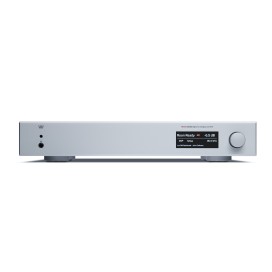
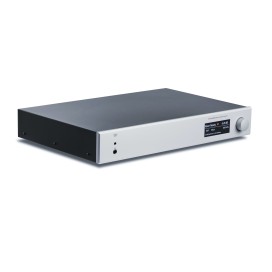
The powerhouse in a new version - the ultimate network renderer, DAC and headphone amplifier in a compact housing, DAC502-4Ch, with DSP for EQ and room correction on board, now with 4 Channels.
Precision high-end DAC/Preamp with DSP, streaming features, and a 4-channel architecture
The DAC502-4Ch isn’t just one of the best converters on the market, enabling a precise and emotionally engaging rendering of music.
It also includes user-configurable processing options such as room EQ, de-essing, crosstalk reduction, loudness, and vinyl emulation.
The DAC502-4Ch offers digital inputs in multiple formats and provides both balanced and unbalanced analog outputs. All common sample rates up to 384 kHz as well as DSD x64 and x128 are supported.
In addition, the unit functions as a preamplifier, headphone amplifier, and streamer (UPnP/ROON).
The DAC502-4Ch also integrates seamlessly with the JPLAY iOS app—so you can enjoy your favorite tracks from Qobuz, Tidal, and your local library in one unified collection.
The DAC501(-4Ch) and DAC502(-4Ch) are identical, except that the latter has a larger chassis and an additional 4-pin headphone socket on the rear panel. Both models are available in aluminum or black.

The simple explanation is that the new DAC chip itself supports 4 channels. That alone improves the stereo signal, because two DAC channels can be used per audio channel—then, after an internal comparison, only the better signal is output.
Since the main difference in the new version is this module plus the matching software, any DAC501/502 can also be upgraded to the 4Ch version.
Note: These are not current DAC features, but they could potentially be added via software update if there is enough interest.
Some more “exotic” ideas that still need refinement during the design process:
| Digital inputs | Five digital stereo inputs: AES/EBU or S/PDIF via XLR, Toslink and RCA; UPnP/DLNA via Ethernet; USB; Roon Ready |
| Accepted formats | PCM 44.1 kHz up to 384 kHz; DSD 64× / 128× |
| Analog outputs | Line out unbalanced (RCA), line out balanced (XLR), headphone out (1/4"), headphone out (4-pin XLR) |
| Output stages | Discrete output stages for line and headphone outputs; no sound-degrading servo mechanisms |
| Level setting | Output levels adjustable in four coarse steps; line and headphone levels can be set independently |
| DSP / algorithms | Room Equalizer, Creative Equalizer, De-Essing, Constant Volume, Vinyl Emulation, Crosstalk Cancelling (XTC, speaker playback), Loudness Control, Headphone Equalizer, Crossfeed |
| Front panel | Rotary encoder (parameters/power), color touchscreen LCD, 1/4" headphone socket, IR receiver |
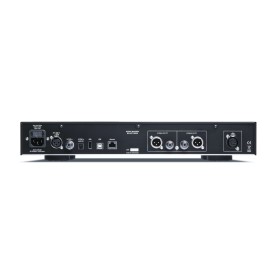
| Rear panel | Analog outputs on XLR/RCA; digital inputs on XLR/RCA/TOSLINK/USB/Ethernet; USB type-A; mains connector with fuses |
| Dimensions (DAC502) | Depth 30 cm (11.8"); width 45 cm (17.7"); height 6.6 cm (2.6"); height with feet 7.4 cm (2.9") |
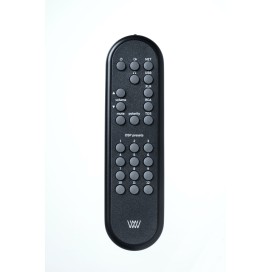
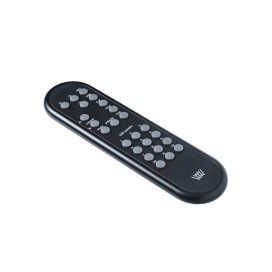
| IR Remote dimensions | Depth 2.1 cm (0.83"); width 4.5 cm (1.78"); height 16.6 cm (6.53") |
| Power supply | Powerful non-switching PSU; dedicated regulators for sensitive voltages separated between left/right; semiconductor relay switches at mains zero crossings; two toroidal transformers; automatic mains voltage selection (measured before powering the electronics) |