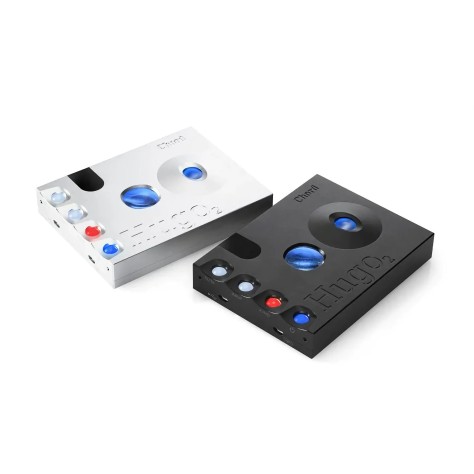
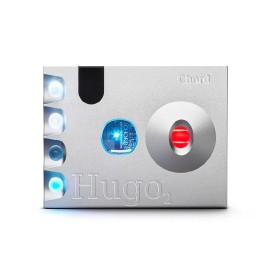
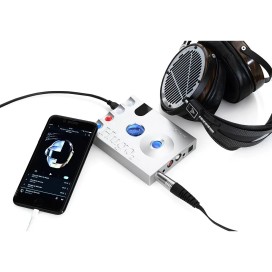
Developed by Rob Watts as the ultimate "portable" headphone amplifier, it is of a quality that can easily compete with most stationary units: Hugo 2.
Portable reference DAC & headphone amplifier with FPGA, WTA filtering and Bluetooth®
In 2014, Chord launched the original Hugo — a revolutionary portable DAC and headphone amplifier that quickly became a milestone in the audio world. Advances in digital technology, including the latest FPGAs and WTA (Watts Transient Aligned) filtering, made it possible to introduce a next-generation version: Hugo 2, offering flexible new features as well as next-level technical and sonic performance.
Winner of “Best DAC (£1,500+)” at the What Hi-Fi? Awards 2022, and a What Hi-Fi? Best DAC winner every year since release (2017–2022), Hugo 2 is a proven class leader.
Hugo 2 can be used both at home and on the go, either with headphones or as part of a conventional audio system. Its line-level output and fully functional remote control bring real flexibility to full-size and desktop systems.
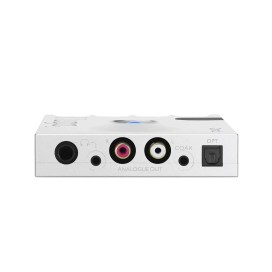
The unit provides four digital inputs (optical, coaxial and HD-USB) plus advanced Bluetooth® wireless technology. Via its HD-USB input, Hugo 2 supports high-resolution playback up to 768 kHz and up to DSD512 (Octa-DSD). Analog outputs include 2 × RCA as well as 3.5 mm and 6.35 mm headphone outputs.
A 4-band switch filter offers a substantial degree of EQ — from warm and smooth to transparent and incisive — adding extra flexibility and user control. For headphone listening, Hugo 2 also features three digital crossfeed modes.
Four spherical control buttons use colour coding to indicate performance, input, filtering and crossfeed settings.
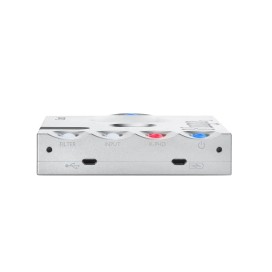
Battery life is around 6+ hours (depending on headphones). Two automatic charging modes are included via the dedicated micro-USB charging port; an indicator shows charging and battery status.
| Chipset / FPGA | Chord Electronics custom-coded Xilinx Artix 7 (XC7A15T) FPGA |
| Tap-length (filter) | 49,152 |
| Pulse array | 10-element Pulse Array design |
| Frequency response | 20 Hz – 20 kHz (±0.2 dB) |
| Output stage | Class A |
| Output impedance | 0.025 Ω |
| THD | <0.0001% (1 kHz, 3 V RMS, 300 Ω) |
| THD + noise (3 V RMS) | 120 dB @ 1 kHz, 300 Ω, ‘A’ weighted (reference 5.3 V) |
| Noise | 2.6 µV ‘A’ weighted; no measurable noise-floor modulation |
| Signal-to-noise ratio | 126 dB ‘A’ weighted |
| Channel separation | 135 dB @ 1 kHz, 300 Ω |
| Power output @ 1 kHz / 1% THD | 94 mW @ 300 Ω 740 mW @ 32 Ω 1050 mW @ 8 Ω |
| Materials | Precision-machined aluminium casing with polycarbonate buttons, acrylic signal window, and glass viewing portal. Colours: natural silver or satin black |
| Battery | 2× Rechargeable custom Enix Energies 3.7 V / 9.6 Wh Li-ion (2600 mAh) |
| Playtime | Approx. 6 hours (average) |
| Charging | Nominal 6 hours via micro-USB at 1.8 A (fast charge) Nominal 8 hours at 1 A (slow charge) |
| Connectivity (inputs) | Micro-USB (White): 44.1–768 kHz, 16–32 bit Coax via 3.5 mm (Red): 44.1–384 kHz, 16–32 bit Coax Dual Data mode via 3.5 mm (Yellow): 44.1–768 kHz, 16–32 bit Optical (Green): 44.1–96 kHz, 16–24 bit |
| Connectivity (wireless input) | Bluetooth® (aptX) (Blue): 44.1–48 kHz, 16 bit |
| Connectivity (outputs) | 1× ¼" headphone output 1× 3.5 mm headphone output 1× stereo RCA (L&R) output |
| PCM support | 44.1 / 48 / 88.2 / 96 / 176.4 / 192 / 352.8 / 384 / 717.6 / 768 kHz, 16–32 bit |
| DSD support | Native playback supported; DSD64 (Single) to DSD512 (Octa-DSD) |
| Volume control | Digital, in 1 dB increments. Last known state saved upon shutdown (except line-level mode) |
| Line-level mode | Activated via dual press of middle ‘Source’ and ‘Crossfeed’ buttons. Line level = 3 V via all outputs. Reset by power cycle |
| Power saving mode | Auto-shutdown after 10 minutes of input inactivity |
| Driver support | Driverless with Mac OS X and Linux; driver required for Windows |
| Weight | 365 g |
| Dimensions (H × W × D) | 2.1 cm × 10 cm × 13 cm |
| Boxed dimensions (H × W × D) | 8.5 cm × 12.2 cm × 22 cm |