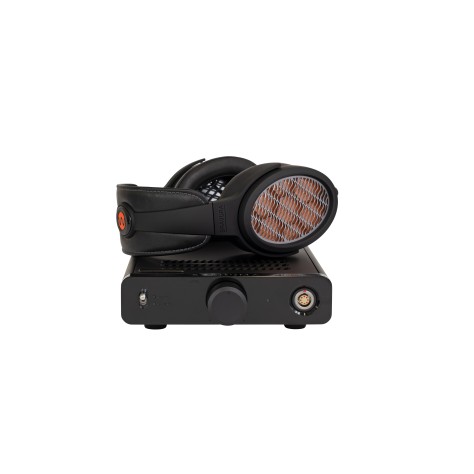


A top-class electrostatic system - with headphones and amplifier at the highest level, at a reasonable price.
Reference electrostatic system with Sonoma M1 Class-A amplifier
Taste is subjective. But when the goal is faithful, uncompromising sound reproduction, Warwick Acoustics takes a very deliberate route: a proprietary electrostatic headphone designed around an extreme bias voltage and built to work exclusively with the Sonoma M1 Class-A amplifier.
The result is a fully matched, tightly engineered system that competes in the price range of flagship headphones alone — yet can, depending on preference and chain, outperform them in key areas.
Electrostatic transducer, luxurious headband, magnesium ear cups for a light and effortless fit — Bravura.
“Everything I wish I used to get out of a Stax headphone... the bass is deep and extended (...), the staging is great, the resolution is there, it just. feels. right. Some of the best sounding bass that I have heard in a headphone, period. Once you hear the quality, and detail, and bass this produces, it's hard to go back.”
“Fucking Phenomenal. (...) Beautiful upper treble extension, one of the most resolving headphones you can get.”
“This reminds me a lot of the (Sennheiser) HE-1, one of the most honest vocal reproductions out there.”
Bravura is built around a proprietary concept: an HPEL electrostatic transducer with an extreme bias voltage, engineered for control, resolution, and natural tone — and conceived as a complete system.

The Sonoma M1 integrates the DAC as the core and uses a custom 64-bit DSP to apply a dedicated EQ curve for the Bravura — aiming for a system-level performance that’s consistently exceptional.
Alongside USB and S/PDIF, you get analog inputs (RCA and 3.5 mm). Those analog signals are not simply passed through: a high-quality ADC digitizes them, helping the system maintain a consistent sonic signature regardless of source.

If you’d like to experience it before buying: ask for a demo if you’re in Bari (or nearby) — or borrow the system for up to two weeks.
| Configuration | Open-back, circumaural |
| Transducer | HPEL, single-ended electrostatic |
| Effective Diaphragm Area | 3570 mm² |
| Transducer Capacitance | 105 pF |
| THD | 0.1% (1 kHz / 100 dB SPL) |
| Frequency Response | 10 Hz – 60 kHz |
| Bias Voltage | 1350 Vdc |
| Cable | 6.6' ultra-low capacitance, high-precision cable |
| Weight | 14.2 oz (403 g) without cables |
| USB Input | USB-B 2.0 | up to 32-bit/384 kHz PCM and DSD via DoP (DSD64/DSD128) |
| Digital Coaxial Input | S/PDIF (up to 24-bit/192 kHz PCM) |
| Analog Input (High Level) | Dual RCA | 2.1 Vrms |
| Analog Input (Low Level) | 3.5 mm | 850 mVrms |
| DAC | Dual-mono, 32-bit/384 kHz DACs with balanced outputs |
| ADC | 32-bit/384 kHz multi-channel ADC with balanced input buffers |
| Digital Signal Processing (DSP) | 64-bit (double-precision) fixed-point processing at native sample rates |
| Amplifier/Energizer | Discrete FET, single-ended, high-bias Class-A output |
| Distortion + Noise | < 0.05% |
| Bandwidth | > 65 kHz |
| Enclosure | CNC-machined 6063 aluminum |
| Power Supply (External) | 24 VDC, 60 VA, fixed frequency, class B-compliant SMPS |
| Power Supply (Internal) | Fully isolated, ultra-low noise linear regulation |
| AC Mains | World voltage compatible (90–264 V, 50–60 Hz) | IEC-60320 C14 | 5' power cable |
| Dimensions | 11.42" × 7.48" × 2.24" (290 × 190 × 57 mm) |
| Weight | 5.40 lbs (2.45 kg) |