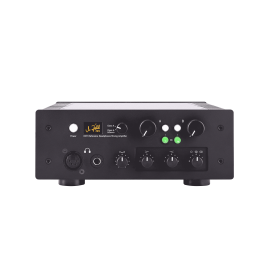
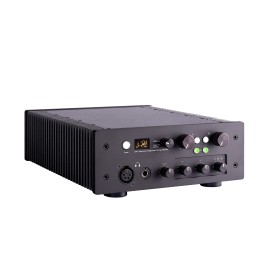


This is a device that I hoped to be able to offer for a long time, as soon as it cemented itself as the gold standard for transparency and power - and now it is here: the Zähl HM1.
A studio-bred reference headphone amplifier — uncompromising transparency, genuinely unique features
In the professional studio world, Michael Zähl has long been considered one of the go-to names for high-end analog electronics. With the HM1, he turned his attention to a headphone amplifier as a passion project — and placed it right at the top of the list where true reference gear with seemingly unmatched transparency lives.
It’s not only built to an uncompromising sonic standard — thanks to hand-selected components and a heavily shielded design — it also brings a few clever studio-inspired ideas that are highly unusual in the hi-fi world:

Here you can see the two input blocks, each accepting either RCA or XLR. Since connecting sources is a less frequent task, the selector sits on the rear panel: choose which input is active — and whether an optional +15 dB gain should be applied. On the front panel, however …

… you’ll find something you rarely (if ever) see elsewhere: each input can be activated independently and blended continuously.

Two knobs — one for bass, one for treble — let you fine-tune the music subtly to your preference. When the EQ isn’t used, the signal bypasses the circuit entirely, so it has no influence on the sound.
But the third control is the real highlight:
Stereo width adjustment without altering the frequency response — no crossfeed
You may have tried crossfeed before and realized it’s not for you. That’s often because the signal is treated as “left” and “right,” with some of the left channel fed into the right (and vice versa). This can create unwanted frequency interactions — often with bass attenuation — and can also compromise imaging because elements are no longer exactly where they were intended to be.
This stereo-width circuit works differently: think of the signal split into “mid” and “side.” Mid is everything that is equally loud in left and right — which we perceive as coming from the center.
Side is everything that is louder on either the left or the right — which we perceive as coming from the sides. Turn the control to the left and the sides become quieter while the center becomes more present.
Turn it to the right and the sides become louder, expanding the perceived stage. Even when you understand how it works — and you’re turning the knob yourself — the effect can still “trick” you into hearing a larger stage, all without touching the frequency domain.
Beyond that, the HM1 offers two sound modes: pure Class A, and Class A with feedback. It’s a total package that truly stands on its own.
All of this engineering comes at a price — not only financially, but also in Michael Zähl’s personal time. Since each unit is hand-built, only 50 pieces are made worldwide per year. If you’re interested, please enquire — and I’ll get back to you.
| Inputs / outputs | Line inputs (balanced) – impedance 20 kΩ – max level +23 dBu Line outputs (balanced) – impedance 47 Ω – max level +23 dBu Transformer-like behaviour: hot or cold may be connected to ground without loss Line inputs (unbalanced) – impedance 20 kΩ – max level +23 dBu Line outputs (unbalanced) – impedance 47 Ω – max level +23 dBu |
| Headphone output | Impedance: Class A 0.8 Ω, Class A & Servo 0.045 Ω Max level: +23.5 dBu (+/−16.5 V) |
| Output power (per side) | RMS: 4 W / 30 Ω; 7 W / 15 Ω Peak: 7.6 W / 30 Ω; 11 W / 15 Ω; 12 W / 10 Ω (18 W for 1.5 ms) |
| Frequency response | 10 Hz … 30 kHz ±0.05 dB 1 Hz … 500 kHz better than −3 dB at headphone output @ +6 dBu |
| Gain | Line to line: 0 dB or +15 dB (switchable on rear panel) Line to headphones: +6 dB or +15 dB (switchable on rear panel) |
| Noise | 20 Hz … 20 kHz flat RMS / A or B active XLR / RCA output: −102 dBu Headphone output: −97 dBu |
| Headphone output THD | Class A: 0.07% Class A & Servo: 0.0005% (typ. @ +20 dBu / 7.75 Vrms / 30 Ω load / 2 W RMS) |
| Power supply | Mains voltage: AC 50–60 Hz, switchable 100 V / 110 V / 120 V / 220 V / 230 V / 240 V Power consumption: typ. 40 W, max. 60 W |
| Dimensions & weight | HM1: approx. 225 × 90 × 300 mm (W × H × D), approx. 5 kg HMP1 (mains adapter): approx. 170 × 60 × 185 mm (W × H × D), approx. 1.2 kg |