- New
Portable high-end DAC/headphone amplifier featuring ELISA spatial imaging, AKM flagship DAC architecture and exceptional power for everything from sensitive IEMs to demanding planar headphones.
Portable High-End DAC/Headphone Amplifier with ELISA Spatial Imaging
The AUDMA Brioso PHPA1 is not a conventional portable DAC/headphone amplifier. It is a serious high-end device in a pocket-sized format, combining the drive capability of a powerful desktop amplifier with one of the most interesting spatial technologies currently available in headphone audio: ELISA.
While many portable audio devices focus on long feature lists, displays, streaming apps or operating systems, AUDMA takes a different approach with the Brioso. This device is about the audio signal itself: clean conversion, powerful amplification, precise control over the headphone load and a spatial presentation designed to move beyond the typical “inside-the-head” experience of traditional headphone listening.
Inside, the Brioso uses a high-grade DAC architecture built around the AKM AK4499EXEQ and AK4191EQ, combined with an unusually powerful amplifier section, four gain levels, selectable output voltage and analogue inputs for external sources. It can be used as a USB DAC, as a pure headphone amplifier, or as the portable centrepiece of a no-compromise headphone system.
The result is a genuinely ambitious portable headphone amplifier: powerful, flexible, mature in sound – and, thanks to ELISA, clearly different from almost everything else in the traditional DAP and DAC/amp category.
- Exceptional power reserves in a chassis barely larger than a smartphone
- Neutral, highly resolving sound with a natural sense of musicality
- ELISA expands stage, imaging and bass control in a more natural way than conventional crossfeed
The Brioso PHPA1 received the Watercooler Prize – Best Portable System 2025 as well as the Fedeltà del Suono Top Quality 2025 award. Both distinctions underline the unusual combination of portable design, very high output power and ELISA spatial imaging.
At AXPONA 2026, ELISA was presented as a distinct approach to headphone spatialisation: not simply making the image wider or artificially larger, but recreating key spatial cues of a loudspeaker setup through controlled timing and level information.
The word “portable” is often used rather generously in high-end audio. Many battery-powered devices are technically movable, but in practice they feel more like transportable desktop components: large, heavy, awkward and not especially pleasant to use on the go. The AUDMA Brioso is different. Its chassis measures just 8.1 × 1.9 × 13.8 cm and weighs approximately 240 g. That places it in a category that can genuinely be called portable.
Yet the Brioso is neither a lifestyle dongle nor an accessory for casual listening. It is a serious headphone amplifier with up to 2 × 4 W into 64 Ω, a selectable output stage and four gain settings. This gives it an unusually broad operating range: from sensitive in-ear monitors to demanding dynamic and planar magnetic headphones.
That is where the Brioso becomes special. It is not designed to be as small and inexpensive as possible. It is designed to deliver the level of control, authority and sonic stability that listeners usually associate with stationary equipment. For many headphones, it can take on the role normally reserved for a powerful desktop DAC/amp.
ELISA stands for Electronic Loudspeaker Imaging Simulating Amplifier. The name already describes the core idea: AUDMA aims to create a headphone listening experience that comes closer to the spatial behaviour of loudspeakers.
With loudspeakers, the signal from the left speaker does not reach only the left ear. It also reaches the right ear, slightly delayed and at a lower level. The same happens in reverse with the right speaker. Our brain uses these tiny differences in time, level and direction to interpret position, depth and distance. In conventional headphone playback, much of this information is missing because the left channel arrives almost exclusively at the left ear and the right channel almost exclusively at the right ear.
The result is familiar to many headphone listeners: headphones can sound extremely detailed, direct and precise, but the stage often remains inside the head or very close to it. Vocals may be centred, yet not truly positioned in front of the listener. Instruments can be sharply separated left and right, while the natural illusion of a physical acoustic space does not always emerge.
ELISA addresses precisely this issue. The circuit uses controlled timing behaviour and gives the listener direct control over the spatial presentation through the Stage and Angle controls. This is not a simple “wide” effect and not a basic bass or ambience filter. The aim is a more coherent spatial presentation, where voices and instruments appear less isolated at the ears and more plausibly positioned in front of the listener.
Crossfeed is not a new concept in headphone audio. Traditional crossfeed mixes part of the left channel into the right channel and vice versa, usually with level reduction and a short delay. This can make extreme left-right panning more comfortable and can help older stereo recordings feel more natural. Many implementations, however, come with compromises: the stage becomes smaller, transparency decreases, treble can feel softened or the effect can seem too broad and insufficiently adjustable.
AUDMA takes a more sophisticated route with ELISA. Instead of simply blending a fixed amount of each channel into the other, ELISA gives the listener meaningful control. Stage influences the perceived distance and depth of the presentation. Angle adjusts the apparent width or angle of the virtual sound source. A dedicated Bass control allows the low-frequency response to be adapted to the headphone and the listener’s taste.
In practice, this means the Brioso is not merely an “on/off” spatial effect. It can be dialled in carefully. With some headphones, a subtle Angle setting can improve centre focus and forward placement. With others, a wider angle can create a more open presentation. Stage allows the effect to feel either more pronounced or more restrained. ELISA becomes a tool rather than a fixed preset.
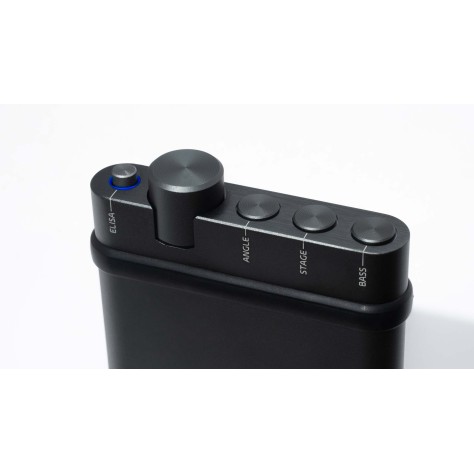
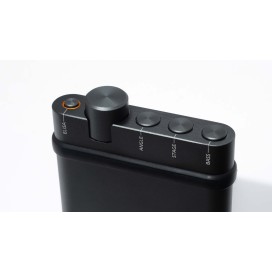
The three ELISA-related controls are placed prominently on the top of the Brioso and are designed as push-pull potentiometers. Once adjusted, they can be pressed back into the body of the device. This protects them from accidental movement and keeps the unit compact during portable use.
Stage controls the intensity and perceived distance of the spatial presentation. Increasing Stage can make the image detach more clearly from the head and create a stronger impression of depth. Reducing Stage brings the presentation closer to a traditional headphone sound.
Angle determines the perceived angle of the sound source. This control is especially important because headphones vary widely in how they present width, centre image and forward projection. Angle can tighten the image or open it up, depending on the headphone and recording.
Bass is not intended as a crude loudness switch, but as a useful low-frequency adjustment. With planar magnetic headphones or very neutral in-ear monitors, a gentle lift can add body, foundation and dynamic weight without reshaping the entire tonal balance.
On the digital side, the Brioso uses a modern high-end architecture from AKM. At its core are the AK4499EXEQ and AK4191EQ. The AK4191EQ handles digital modulation and filtering, while the AK4499EXEQ performs the premium D/A conversion. This separation between digital processing and analogue conversion is a key aspect of AKM’s current flagship architecture.
The advantage of this design lies in its clean division of tasks. Digital processing and analogue conversion are no longer treated as tightly packed sections of a conventional DAC implementation, but are organised in a more discrete way. The goal is lower noise, high transparency and a sound that remains technically precise without becoming sterile.
The Brioso supports digital signals up to 32-bit / 768 kHz PCM and DSD256. In real-world listening, this is not only about exotic file formats. It also shows that the digital platform is not an afterthought. The Brioso is not merely an analogue amplifier with a USB input added on. It is a fully capable DAC/amp in its own right.
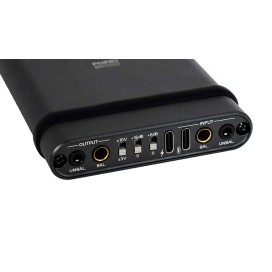
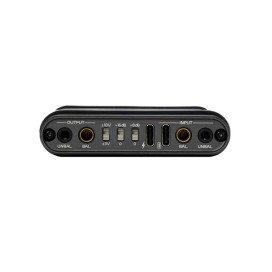
A portable amplifier is only convincing when it can do more than simply play loud. It must also remain finely controllable. The Brioso offers four gain settings: 0 dB, +8 dB, +16 dB and +24 dB. In addition, the output stage can be switched between ±3 V and ±10 V. This allows the user to adapt the amplifier to very different headphones.
With sensitive IEMs, low gain is essential for maintaining a usable volume range and keeping the noise floor low. With demanding planar magnetic or dynamic over-ear headphones, voltage swing, current capability and stability become more important. The Brioso is designed precisely for this wide operating range.
The power figures are exceptional for a device of this size: 2 × 2.0 W into 32 Ω, 2 × 4.0 W into 64 Ω and 2 × 2.7 W into 150 Ω. This makes the Brioso much more than a loud portable device. It has real reserves for headphones that may become sufficiently loud from ordinary mobile outputs, but still sound flat, compressed or dynamically restrained.
Sonically, the Brioso does not aim for cheap spectacle. With ELISA disengaged, it presents itself as a clean, neutral and controlled high-end DAC/amp with high resolution, strong dynamics and excellent stability. Its basic character is not artificially warm, but it is not cold or clinical either. It sounds precise, powerful and mature.
The bass range benefits clearly from the muscular amplifier section. Planar magnetic headphones gain authority, control and physical credibility. This is particularly noticeable with headphones that may reach enough volume from weaker sources, yet never fully come alive. With the Brioso, transients have more substance, dynamic swings feel more effortless and the low end stays tighter.
The midrange remains transparent and easy to follow. Vocals sit clearly in the mix without being artificially pushed forward. Instruments retain body and texture. The treble is detailed, but not exaggerated. The AKM conversion contributes to a presentation that combines technical precision with musical ease.
With ELISA engaged, the tonal balance does not change as much as the spatial perception. The soundstage detaches more convincingly from the head, centre information appears more naturally positioned and recordings with strong spatial information can become significantly more believable. The effect is at its best when used with restraint. Properly dialled in, ELISA does not feel like an effect. It feels like a correction of one of the fundamental limitations of headphone playback.
The Brioso is flexible without becoming unnecessarily complicated. On the digital side, it offers a USB-C input. On the analogue side, it provides 4.4 mm balanced and 3.5 mm single-ended inputs. Headphone outputs are also available as 4.4 mm Pentaconn and 3.5 mm.
This allows the Brioso to be used in several ways. With a smartphone, tablet, computer or DAP, it functions as a USB DAC/amp. With a high-quality external DAP or DAC, it can be used purely as an analogue amplifier. If you already have a preferred source, you do not have to replace it. The Brioso can instead become the amplifier and ELISA centrepiece of the system.
The second USB-C port is used for charging. The internal battery is a 1950 mAh / 7.6 V LiPo cell and enables up to 5 hours of playback depending on volume, headphone load and operating mode. With very demanding headphones and high output voltage, battery life will naturally be shorter, but in return the Brioso delivers a level of output power rarely found in this size class.
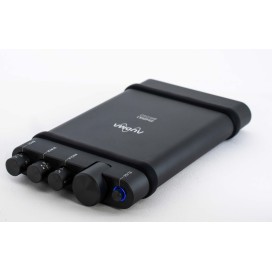
The chassis is made from solid aluminium with an anodised finish. It is deliberately clean and functional, with no overloaded display, no app dependency and no menu system. Operation is direct and physical: volume, ELISA activation, Stage, Angle, Bass, plus rear switches for gain and output adjustment.
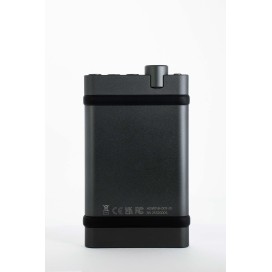
Two silicone bands on the chassis improve grip and help protect both the Brioso and the surfaces on which it is placed. It is a small but practical detail. A device of this class will often be used together with premium DAPs, smartphones and headphones, and no one wants unnecessary scratches or slipping.
The push-pull controls are especially well considered. When pulled out, Stage, Angle and Bass can be adjusted precisely. Afterwards, they can be pushed back into the chassis. This keeps the device slim during portable use and prevents accidental changes to the settings.
The Brioso is not for someone simply looking for an inexpensive USB dongle. It is aimed at listeners who already own high-quality headphones and do not want to give up serious amplification when listening away from a main desktop system.
It is especially interesting for owners of demanding over-ear headphones. Many high-end headphones can become loud enough from DAPs or mobile DACs, but only reveal their full dynamics, control and spatial stability when driven by a stronger amplifier. This is exactly where the Brioso fits.
It is also compelling for listeners who have never been fully satisfied with the typical headphone soundstage. If you love loudspeaker listening but often rely on headphones for practical reasons, ELISA offers one of the most convincing ways to shape spatial perception more consciously and naturally.
For IEM users, the Brioso can also make sense when a powerful, high-quality and highly flexible amplifier is desired. Thanks to the low gain setting and ±3 V mode, it can be used sensibly with more sensitive earphones, while still leaving the door open for more demanding headphones later on.
Many high-end DAPs try to be everything at once: player, streamer, DAC, amplifier, app platform and user interface. That can be convenient, but it often introduces compromises. A significant part of the budget goes into the display, processor, operating system, storage, Wi-Fi, streaming certification and software maintenance.
The Brioso takes another path. It is not a player. It does not try to manage a music library or replace your streaming apps. Instead, it focuses on what actually determines playback quality: high-grade conversion, powerful amplification, proper matching to different headphones and ELISA spatial imaging.
In combination with an existing smartphone or DAP, this can be more sensible than buying another complete player. You keep the source you already know and gain an amplification and sound-processing stage that goes far beyond typical mobile outputs.
The AUDMA Brioso PHPA1 is one of the most distinctive portable high-end devices in its class. It combines the functionality of a high-quality USB DAC with the power of a serious headphone amplifier and adds ELISA – a technology that does not simply aim for more width, but addresses the spatial foundations of headphone playback in a much more deliberate way.
If you are looking for the smallest, cheapest or most feature-packed all-in-one device, the Brioso is not the right answer. But if you want a compact, uncompromising DAC/amp that can drive serious headphones with authority and genuinely influence spatial presentation, the Brioso deserves close attention.
The Brioso is not an accessory. It is a true high-end headphone tool – portable, powerful and sonically unique.
| Device Type | Portable DAC/headphone amplifier with ELISA spatial imaging |
| Analogue Inputs | 4.4 mm balanced (Pentaconn), 3.5 mm single-ended |
| Digital Inputs | USB-C |
| Input Impedance | 100 kΩ |
| DAC | AKM AK4499EXEQ + AK4191EQ |
| Resolution | Up to 32-bit PCM / 768 kHz and DSD256 |
| Headphone Outputs | 4.4 mm balanced (Pentaconn), 3.5 mm single-ended |
| Headphone Compatibility | Nominal impedance ≥ 6 Ω |
| Output Gain | Selectable: 0 / +8 / +16 / +24 dB |
| Output Voltage | Up to 40 V peak-to-peak |
| Output Power at 32 Ω | 2 × 2.0 W (1 kHz) |
| Output Power at 64 Ω | 2 × 4.0 W (1 kHz) |
| Output Power at 150 Ω | 2 × 2.7 W (1 kHz) |
| Output Drive | Selectable ±3 V / ±10 V |
| Signal-to-Noise Ratio | 115 dB |
| Frequency Response | 20 Hz – 20 kHz ± 0.01 dB |
| ELISA Controls | On/Off, Stage, Angle |
| Additional Controls | Bass, volume |
| Battery | LiPo 1950 mAh, 7.6 V, up to 5 hours playback |
| Dimensions | 8.1 × 1.9 × 13.8 cm (W × H × D) |
| Weight | 240 g |
| Awards | Watercooler Prize Best Portable System 2025; Fedeltà del Suono Top Quality 2025 |