- New
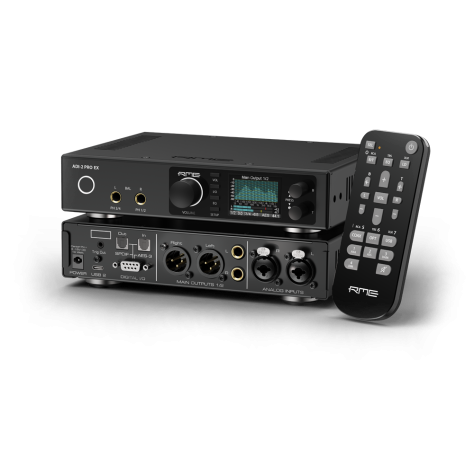
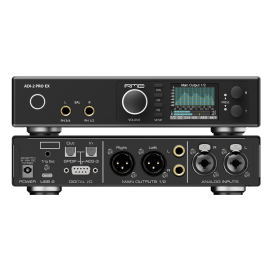
RME ADI-2 Pro EX reference DAC, AD/DA converter and powerful headphone amplifier with DSP, USB-C, AES, ADAT and DSD256 support.
Reference AD/DA converter, DAC, headphone amplifier and digital audio centre
The RME ADI-2 Pro EX is one of those rare devices for which the term “all-in-one” is not an oversimplification, but almost an understatement. It combines a high-precision AD/DA converter, a powerful dual headphone amplifier, a USB audio interface, a digital format converter, a flexible preamplifier and a comprehensive DSP system in a single compact enclosure.
Yet the ADI-2 Pro EX is not a compromise product designed to cover as many functions as possible at an acceptable level. Each of its core tasks has been implemented to a professional reference standard, with extremely low distortion, a wide dynamic range, finely graduated analogue reference levels, RME SteadyClock FS, powerful internal signal processing and a user interface that makes even complex functions clearly accessible directly from the device.
The ADI-2 Pro EX can therefore serve equally well as the centrepiece of a demanding headphone system, the primary converter in a mastering or recording setup, a precise preamplifier for active loudspeakers or a high-quality front end for audio measurements. It draws no artificial line between hi-fi and studio use: it delivers the technical precision of professional studio equipment while combining it with functions that make a genuine difference in everyday listening.
The result is not simply a DAC with a few additional features, but a complete reference system for anyone who does not wish to separate sound quality, control and flexibility.
The ADI-2 Pro EX can be used in a wide variety of ways. In a conventional hi-fi system, it functions as a USB DAC, digital preamplifier and headphone amplifier. In the studio, it handles high-quality conversion between the analogue and digital domains, serves as a monitor controller and enables precise assessment of recordings over both loudspeakers and headphones. Through AES, SPDIF and ADAT, it can also connect, synchronise and convert between different digital formats.
Its two analogue input channels can accept high-quality line signals up to +24 dBu. On the output side, there is a stereo XLR output, an additional stereo TRS output and two Extreme Power headphone outputs. Internally, the ADI-2 Pro EX operates with two stereo D/A paths, allowing the main output and headphone output 3/4 to be used with separate settings, volume levels and equalisers.
Via USB, the device can be operated either as a particularly straightforward stereo interface with 2 inputs and 2 outputs or as a multichannel interface with 6 inputs and 8 outputs. This keeps operation simple in a pure hi-fi system while providing substantially more channels for studio, routing and measurement applications.
The ADI-2 Pro EX builds on the proven ADI-2 Pro FS R Black Edition but has been revised in several important areas. The new, slightly larger enclosure follows the visual design of the ADI-2/4 Pro while also improving thermal conditions through additional ventilation. Chrome-plated feet, a clean front panel and the robust desktop format underline its credentials as a durable reference device.
The previous USB connection has been replaced by a modern USB-C port with a mechanical locking option. Technically, the connection deliberately remains USB 2.0, as the available bandwidth is fully sufficient for all audio channels and supported resolutions. The device is not powered via USB; a 1.8-metre USB-C cable with a locking connector on one end is included.
Another new feature is a 12-volt trigger output on a 3.5 mm mono jack. This allows compatible power amplifiers, active loudspeakers or other components to be switched on and off together with the ADI-2 Pro EX. Particularly when used as a central preamplifier, this small addition makes daily operation considerably more convenient.
The headphone outputs have also been upgraded in terms of power. Further improvements include separate hardware DC protection for each channel and an active protection circuit at the power input that detects incorrect polarity and overvoltage. The new locking NT-RME-13 power supply can be used worldwide and is designed to reduce leakage current without creating unnecessary ground loops.
The ADI-2 Pro EX uses an AKM AK5574 for analogue-to-digital conversion and an AKM AK4493 for digital-to-analogue conversion. The choice of converter chips alone, however, does not determine the final result. Power supply design, clocking, analogue output stages, level matching, filtering and protection circuitry all determine whether a converter can actually realise its theoretical potential.
RME follows a consistently technical approach. The ADI-2 Pro EX is not intended to add a flattering character of its own, but to reveal as accurately as possible what is present in the recording. Its strengths lie in clean transient reproduction, excellent channel separation, extremely low self-noise and a level of transparency that is equally convincing during critical studio work and concentrated music listening.
PCM signals are supported via USB at up to 32 bit and 768 kHz. The ADI-2 Pro EX also supports DSD recording and playback up to DSD256 or 11.2 MHz. A Direct mode is available for DSD as well. Since a native DSD bitstream cannot be processed in the same way as PCM, DSP functions such as equalisation, crossfeed and loudness are naturally unavailable during direct DSD playback.
Digital audio devices do not merely have to transfer data; they must also process that data according to a precise timing reference. Fluctuations in this timing reference are known as jitter. The ADI-2 Pro EX uses RME SteadyClock FS to synchronise external digital signals reliably and to virtually eliminate the influence of incoming clock fluctuations on the conversion process.
This is particularly important when connecting older CD players, streamers, televisions, professional AES sources or other digital devices with varying clock quality. The ADI-2 Pro EX does not depend on ideal laboratory conditions and continues to deliver stable results even with more problematic input signals.
The comprehensive status display provides direct information about the clock source, detected sample rate and current lock and sync status. Incorrect configurations can therefore be identified during setup rather than merely becoming audible later.
The analogue inputs of the ADI-2 Pro EX use servo-balanced XLR/TRS combination sockets and can be set to +4, +13, +19 or +24 dBu. These four reference levels are implemented in the analogue circuitry and allow optimal adaptation to consumer hi-fi equipment, professional studio devices, external preamplifiers and particularly high-level mastering hardware.
The Auto Reference Level function can automatically switch to the next higher input level if clipping is imminent. A digital trim range of up to +6 dB is also available. This allows the available dynamic range to be used far more effectively than with devices that offer only one fixed consumer or professional level.
The XLR outputs also offer the four reference levels +4, +13, +19 and +24 dBu. The rear 6.3 mm TRS outputs are impedance-balanced and can easily feed unbalanced devices via suitable TS or RCA connections. This allows the ADI-2 Pro EX to integrate just as naturally into a professional rack as into a conventional hi-fi system.
When automatic reference-level control is enabled, the device selects the most appropriate analogue output range according to the selected volume. This avoids unnecessary digital attenuation while maintaining the best possible signal-to-noise ratio. The ADI-2 Pro EX is therefore particularly well suited for direct use as a volume-controlled preamplifier for active loudspeakers or power amplifiers.
The two front-mounted 6.3 mm outputs are not simple monitoring sockets, but complete Extreme Power headphone amplifiers. With an output impedance of just 0.1 ohm, extremely low noise and high current delivery, they are suitable for low-impedance dynamic headphones, demanding planar-magnetic designs and high-impedance studio models alike.
In unbalanced operation, the ADI-2 Pro EX delivers up to 1.9 watts per channel into 32 ohms and up to 2.1 watts into 16 ohms. Into 300 ohms, 0.37 watts per channel are available. At the same time, the amplifier stage remains exceptionally low in distortion under real-world loads: RME specifies a THD value of -122 dB at 1.5 watts into 32 ohms.
Low Power and High Power modes allow meaningful adjustment to very different headphones. This is not merely about maximum volume. Selecting the appropriate operating range improves the usable span of the volume control and keeps self-noise low with more sensitive models.
A comprehensive safety system monitors overcurrent, short circuits, DC voltage and thermal load. The sockets detect when a plug is inserted and raise the volume in a controlled manner. If High Power is active while the volume setting is too high, the device issues a warning and initially keeps the output at a safe level. With an amplifier offering this level of reserve, these protective functions are not an afterthought but a fundamental part of the design.
The main PH 3/4 headphone output is fed by its own stereo D/A path and can be configured independently of the rear main outputs. PH 1/2 uses the D/A path of the main outputs but has its own Extreme Power driver stage. This allows two headphones to be operated and compared in parallel, with individual EQ settings for each.
The Advanced Balanced Phones Mode is particularly interesting. In this mode, both front-mounted TRS outputs are used together: one for the left channel and one for the right. A suitable adapter cable with two 6.3 mm TRS plugs to, for example, a 4-pin XLR connector is required. The mode can be configured so that it activates automatically when both plugs are inserted.
In balanced operation, the maximum output level rises to +28 dBu or 19.5 volts. Up to 4.2 watts per channel are available into 32 ohms and up to 1.4 watts into 300 ohms. RME does not use the balanced architecture solely to increase power, however, but also to improve linearity, reduce distortion and raise the signal-to-noise ratio to as much as 126 dBA.
Please note: the ADI-2 Pro EX does not have a separate 4-pin XLR socket. Balanced Mode requires an appropriately wired adapter cable. During operation in this mode, the rear analogue outputs 1/2 are muted.
The internal DSP is one of the most important differences between the ADI-2 Pro EX and many conventional high-end DACs. Rather than treating all sound processing as an undesirable intervention, RME provides precise, fully controllable tools that can be disabled at any time.
Separate 5-band parametric equalisers are available for the analogue inputs and outputs. These can be used to equalise headphones accurately, correct room influences when using active loudspeakers or implement personal tonal preferences in a clean and repeatable way. Frequency, gain and Q can be adjusted precisely and stored as presets.
Bass and Treble controls are directly accessible and are ideal for quick tonal adjustments. The Loudness function operates according to volume: at lower listening levels, it applies a stronger bass and treble lift, automatically reducing its effect as the volume increases. This compensates for the way human hearing changes with level without permanently altering the tonal balance at normal listening volumes.
A Bauer Binaural Crossfeed function with five intensity levels is also available for headphones. It reduces the hard left-right separation of conventional headphone playback and gently moves the spatial presentation closer to that of loudspeakers. Older recordings with extreme stereo panning in particular can sound considerably more natural as a result.
Further functions include M/S processing, mono, phase inversion, stereo-width adjustment, selectable AD and DA filters and separate volume and tone parameters for different outputs. This makes the ADI-2 Pro EX not only flexible, but exceptionally easy to adapt to different headphones, loudspeakers and listening situations.
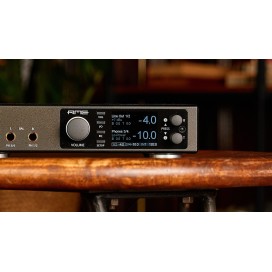
The colour IPS display is not used merely for navigating menus. It shows levels, spectrum, input status, clock status, active processing, output levels and warning messages in real time. The integrated 30-band spectral analyser uses biquad filters and provides a clear, musically useful representation of the current signal.
Despite the extensive functionality, operation remains logical. Three push encoders, direct-access buttons for volume, inputs, outputs, equaliser and setup, and context-sensitive displays allow rapid adjustments without a computer. Device states and EQ configurations can be stored and recalled later with complete consistency.
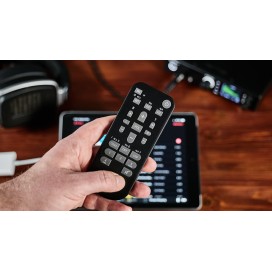
The ADI-2 Pro EX can also be controlled conveniently through the ADI-2 Remote software. The supplied RME Multi-Remote-Control remote provides direct access to volume, mute, balance, bass, treble, EQ, loudness, input selection and numerous freely assignable functions from the listening position.
The optical connection supports both SPDIF and ADAT. The supplied breakout cable also provides coaxial SPDIF on RCA and professional AES/EBU on XLR. This allows the ADI-2 Pro EX to connect digital sources from both the hi-fi and studio worlds without requiring additional converters.
An integrated sample-rate converter can decouple incoming AES or SPDIF signals from the internal clock. This is useful when a source cannot be operated as a clock slave or when several digital devices with different clock domains need to be combined. In addition to conversion itself, the ADI-2 Pro EX can therefore also perform the role of a high-quality digital format and clock converter.
The digital inputs and outputs support sample rates up to approximately 192 kHz or 200 kHz, while the highest PCM rates of up to 768 kHz are available via USB and within the analogue conversion stages.
In a hi-fi system, the ADI-2 Pro EX excels as an exceptionally neutral DAC, a precisely adjustable preamplifier and an unusually powerful headphone amplifier. The remote control, automatic reference-level control, Loudness function and storable headphone EQs make it more convenient in everyday use than many purist high-end components.
In the studio, the focus shifts to its flexible reference levels, high-quality analogue inputs, professional digital formats, M/S processing and reliable clock synchronisation. The ADI-2 Pro EX is suitable for mastering, high-quality stereo recording, external analogue processing, monitoring and the precise digitisation of analogue sources.
Thanks to its DC-coupled outputs, high sample rates and outstanding measurement performance, the device can also be used as an analogue front end for audio measurement systems. Its compact enclosure and ability to operate from an external 9-to-16-volt power source also allow mobile or battery-powered setups where required.
The RME ADI-2 Pro EX is the right choice for listeners and professional users who do not want a collection of partially integrated individual components, but a compact system that performs every task with exceptional precision. It combines transparent AD/DA conversion, enormous headphone power, sophisticated DSP, flexible digital and analogue connectivity and unusually comprehensive operation in one of the most versatile reference devices in its class.
Its greatest strength is not one spectacular measurement figure, but the consistency of the complete concept. The ADI-2 Pro EX is precise enough for mastering and measurement work, powerful enough for demanding headphones and at the same time convenient enough to serve every day as the centrepiece of a high-quality hi-fi system.
| General and conversion | |
| Device type | 2-channel A/D converter, 4-channel D/A converter, USB audio interface, DAC, preamplifier, headphone amplifier and format converter |
| A/D converter | AKM AK5574 |
| D/A converter | AKM AK4493 |
| PCM resolution | Up to 32 bit / 768 kHz via USB |
| DSD | DSD64, DSD128 and DSD256; recording and playback up to 11.2 MHz; DSD Direct Playback |
| Clocking | SteadyClock FS; internal clock and synchronisation via AES, SPDIF or ADAT |
| Analogue inputs | |
| Connections | 2 × XLR/TRS combination sockets, servo-balanced |
| Input impedance | 18 kΩ balanced, 9 kΩ unbalanced |
| Reference levels | +4 dBu, +13 dBu, +19 dBu, +24 dBu at 0 dBFS |
| Digital trim gain | 0 to +6 dB |
| Signal-to-noise ratio | Up to 120 dB RMS / 122 dBA |
| THD at -1 dBFS | -120 dB / 0.0001% |
| THD+N at -1 dBFS | -116 dB / 0.00016% |
| Channel separation | More than 110 dB |
| Analogue line outputs | |
| XLR outputs | 2 × XLR, balanced |
| TRS outputs | 2 × 6.3 mm TRS, impedance-balanced; unbalanced operation possible |
| XLR reference levels | +4 dBu, +13 dBu, +19 dBu, +24 dBu at 0 dBFS |
| Maximum TRS reference level | +19 dBu |
| Signal-to-noise ratio, XLR | Up to 120 dB RMS / 123 dBA |
| THD at 0 dBFS | Below -120 dB / 0.0001% |
| THD+N at 0 dBFS | -115 dB / 0.00018% |
| Output impedance | XLR 200 Ω; TRS 100 Ω unbalanced / 200 Ω balanced |
| Channel separation | More than 110 dB |
| Headphone outputs | |
| Connections | 2 × 6.3 mm TRS stereo, Extreme Power |
| Output impedance | 0.1 Ω unbalanced; 0.2 Ω in Balanced Phones Mode |
| Unbalanced output level | +7 dBu Low Power; +22 dBu / 10 V High Power |
| Unbalanced output power | 2.1 W into 16 Ω; 1.9 W into 32 Ω; 0.37 W into 300 Ω per channel |
| Balanced output level | +13 dBu Low Power; +28 dBu / 19.5 V High Power |
| Balanced output power | 2.7 W into 16 Ω; 4.2 W into 32 Ω; 1.4 W into 300 Ω per channel |
| Signal-to-noise ratio | Up to 123 dBA unbalanced; up to 126 dBA balanced |
| THD at 1.5 W / 32 Ω | -122 dB / 0.000079% |
| Protection functions | Relay mute, plug detection, volume ramp, overcurrent, short-circuit, temperature and separate DC protection for each channel |
| Digital connections | |
| USB | USB-C, USB 2.0, Class Compliant UAC 2, no bus power, locking connector |
| AES/EBU | Input and output on XLR via supplied breakout cable, transformer-coupled and galvanically isolated |
| Coaxial SPDIF | Input and output on RCA via supplied breakout cable |
| Optical SPDIF / ADAT | Optical TOSLINK input and output; compatible with SPDIF and ADAT |
| External clock sample rates | 32 to 200 kHz |
| Internal sample rates | 44.1 to 768 kHz |
| USB channel modes | Stereo: 2 in / 2 out; multichannel: 6 in / 8 out |
| Trigger output | 12 V on 3.5 mm TS mono jack |
| DSP and operation | |
| Equaliser | 5-band parametric EQ for six channels, storable presets |
| Sound-processing functions | Bass, Treble, dynamic Loudness, five-level Crossfeed, Mono, Phase, M/S processing, Stereo Width |
| Filters | Selectable AD and DA filters |
| Display | High-resolution colour IPS display, level meters, status overview and 30-band spectral analyser |
| Remote control | ADI-2 Remote software and supplied RME Multi-Remote-Control infrared remote |
| Power supply and dimensions | |
| Power supply | External NT-RME-13 switching power supply, 100–240 V AC, 12 V / 2 A, 24 W, locking DC connector |
| Permitted DC input voltage | 9 to 16 V DC |
| Power consumption | Approx. 12 W at idle, maximum 24 W |
| Dimensions | 215 × 44 × 160 mm (W × H × D) |
| Weight | 1.15 kg |