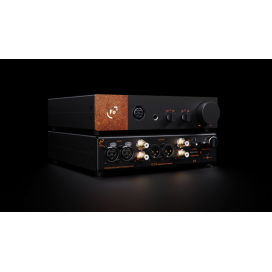
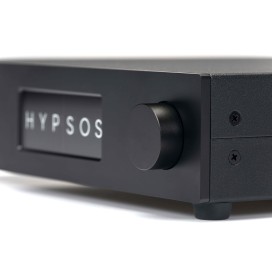
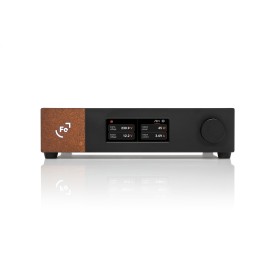
End-game DAC in a small form factor - Wandla. The only DAC powerful enough to run filters by Jussi Laako, developer of HQPlayer, directly on the device.
Reference DAC with HQPlayer filters, flexible tone control, and new GS features
Ferrum has a very distinctive approach when it comes to tailoring sound to personal taste and system needs. Their first product was a power supply designed to improve the performance of other components – and allow additional fine-tuning.
The OOR amplifier offers a bypass mode that sounds different from running the signal through its volume control. And WANDLA stands out by having enough processing power to run selected filters by Jussi Laako (HQPlayer) inside the unit – which is why that ecosystem was integrated right away.
On top of that, you can choose how tone control is handled: digital, analog (still adjustable via remote!), or bypass where the signal is passed at full level.
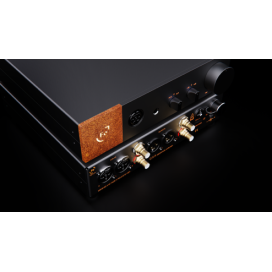
Connectivity is another strong point: HDMI ARC, I2S, AES, USB-C – just to name a few.
A true endgame DAC – now with new features in the Goldensound Edition.
Increases soundstage width and depth, improves separation, and keeps frequency response untouched. It’s not a simple echo effect. It’s not crossfeed either. Two variants are available: Headphone and Speaker mode.
Designed to recreate the sonic character of typical tube amplifiers at the DAC level. This is not an EQ – instead, software reconfigures how the hardware operates.
Impact+ is essentially an EQ profile – not to overwhelm you with bass, but to noticeably increase musical punch.
All three software features can be used at the same time.
Modern music often pushes loudness to the edge of what’s technically possible – and tends to offer less usable dynamic range. A DAC usually has about 3 dB of margin to interpret such signals without hitting its own limits and creating distortion. The WANDLA GS Edition adds another 3 dB so the new software modes won’t introduce distortion either.
WANDLA’s output level can be high enough to overload some downstream amplifiers. Previously, output reduction was done in software, which could reduce headroom. The GS Edition performs this adjustment in hardware, preserving full dynamic range.
| Operation | Fully balanced, proprietary IC power amp |
| DAC chip | ESS Sabre ES9038PRO |
| DAC resolution | 768 kHz / 32-bit, DSD256 |
| Digital inputs | AES/EBU (up to PCM 192 kHz/24-bit, DoP64) Optical S/PDIF (up to PCM 96 kHz/24-bit guaranteed; should work up to PCM 192 kHz/24-bit and DoP64 – depends on user’s optical cable and transmitter) Coaxial S/PDIF (up to PCM 192 kHz/24-bit, DoP64) USB (up to PCM 768 kHz/32-bit, DSD256, DoP256) ARC (up to PCM 192 kHz/24-bit), TV input with CEC I2S (up to PCM 768 kHz/32-bit, DSD256, DoP256), PS Audio® compatible |
| MQA® | Decoder and renderer (on all digital inputs) |
| Analog inputs | RCA |
| Analog input Vmax | 9.5 V RMS (2–3.5 V RMS recommended) |
| Analog input impedance | 47 kΩ |
| Line outputs | Balanced XLR; unbalanced RCA |
| Volume control | Analogue with bypass option / digital for DAC operation only |
| Output level | @0 dBFS, 1 kHz sine: 9.3 V RMS balanced, 4.65 V RMS unbalanced |
| Frequency response | 10 Hz – 200 kHz ± 0.1 dB |
| DAC THD | -121 dB (0.00009%); THD+N: -115 dB (unweighted) |
| Analog input THD | -123 dB @ 2 V RMS output level |
| Dynamic range (analog) | 127 dB (A-weighted) |
| Dynamic range (digital) | 127 dB (A-weighted) |
| Crosstalk | -120 dB at 1 kHz, better than -100 dB for 20 Hz – 20 kHz |
| Output impedance (unbalanced) | 22 Ω |
| Output impedance (balanced) | 44 Ω |
| Power consumption | 10 W idle / 15 W max |
| Power inputs | 5.5/2.5 mm DC connector, centre positive proprietary FPL 4-pin DC connector (FPL) 22–30 VDC |
| Power adapter | 100–240 VAC to 24 VDC |
| Dimensions | 21.7 × 20.6 × 5 cm (W×D×H) / 8.6 × 8.1 × 2.0 inch |
| Weight | 1.8 kg / 3.97 lbs |