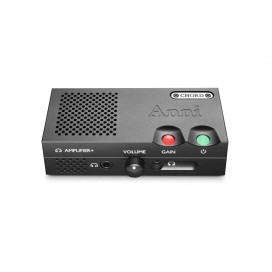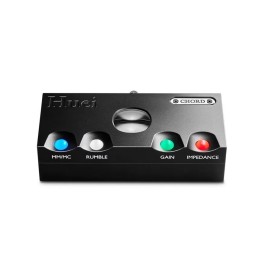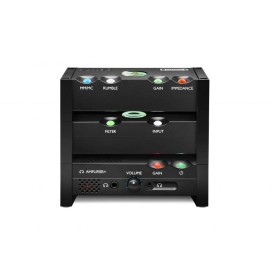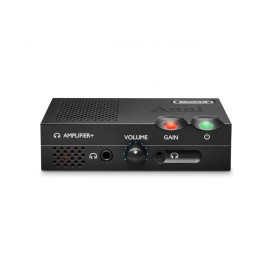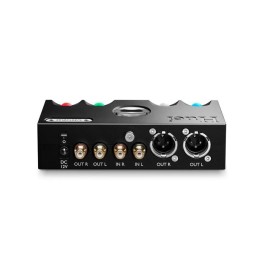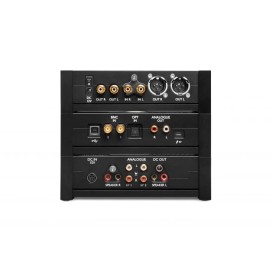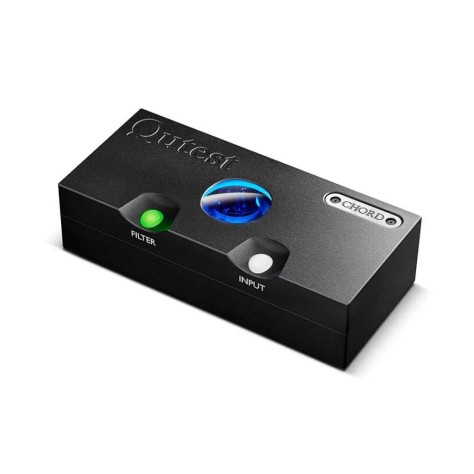
Qutest is a What Hi-Fi? Award-winning DAC with a performance that belies its compact dimensions. With DAC architecture based on Chords class-leading FPGA tech, Qutest offers unrivaled sound quality gains.
Standalone FPGA DAC with galvanically isolated USB and selectable output voltage
The Qutest DAC was designed to instantly upgrade a system’s sound quality. It is the latest evolution of Chord’s most affordable “standalone” DAC, meaning it does not include a built-in headphone amplifier like the Mojo 2 and Hugo 2.
Qutest is What Hi-Fi?’s “Best DAC” 2023 £1,000+ and a What Hi-Fi? “Best DAC” winner every year since its introduction (2018–2022). A proven class leader, it is built around Chord’s award-winning proprietary FPGA technology, delivering unrivalled technical and sonic performance.
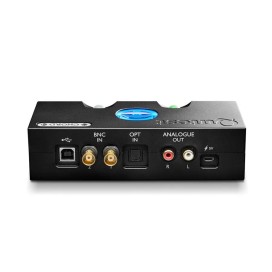
It is perfectly equipped to bring the benefits of Chord’s digital technology to a wide variety of connected devices. With galvanically isolated USB-B, optical, and coaxial digital inputs, it delivers an immediate performance upgrade and provides a way to modernise ageing digital source components.
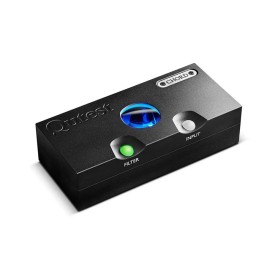
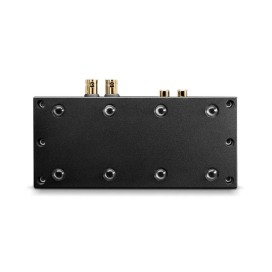
The Qutest chassis is completely new, too. It has significantly more mass than its predecessor and is precision-machined from solid aircraft-grade aluminium. The Qutest PCB sits in a shallow recess within the solid aluminium case, offering better protection than earlier designs and additional isolation from external vibration.
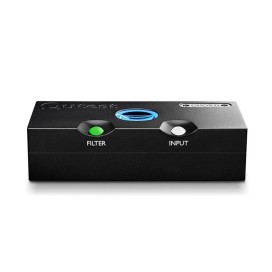
Qutest also offers Hugo 2-derived, user-selectable frequency-shaping filters and input selection via two fascia-mounted spheres, adding useful flexibility. It features analogue RCA outputs for connection to integrated amplifiers, preamps, and headphone amplifiers, plus high-resolution dual-data digital inputs for use with the M-Scaler or future Chord Electronics products.
Another new feature is a user-selectable output voltage, available in 1, 2, and 3 V RMS, enabling flexible partnering with a wide range of equipment.
Qutest is the definitive compact audiophile DAC.
- Materials: Precision-machined aluminium case with polycarbonate buttons and a glass viewing window. Available only in Jet Black.
- Power supply: 5 V / 2 A Micro USB
- Tap length / filter: 49,152 – 10-element Pulse Array design
- Digital designer: Rob Watts
- Mechanical designer: John Franks
- Country of manufacture: England
| Chipset | Chord Electronics custom coded Xilinx Artix 7 (XC7A15T) FPGA |
| Tap length | 49,152 |
| Pulse array | 10-element Pulse Array design |
| Frequency response | 20 Hz – 20 kHz ± 0.2 dB |
| Output stage | Class A |
| THD | <0.0001% (1 kHz, 3 V RMS, 300 Ω) |
| THD + noise at 3 V RMS | 117 dB at 1 kHz, 300 Ω, A-weighted (reference 2.5 V) |
| Noise 2.6 µV (A-weighted) | No measurable noise floor modulation |
| Channel separation | 138 dB at 1 kHz, 300 Ω |
| Selectable output voltage | Fixed, but selectable: 3 V (blue), 2 V (green), 1 V (red) by double-pressing “Filter” + “Input” at startup |
| Driver support | Driverless with macOS and Linux; Windows driver required |
| Connectivity (inputs) | USB Type B (white): 44.1 kHz to 768 kHz – 16 to 32 bit 2× BNC coax (red): 44.1 kHz to 384 kHz – 16 to 32 bit Dual-data mode (both BNC used together): 44.1 kHz to 768 kHz – 16 to 32 bit Optical (green): 44.1 kHz to 96 kHz – 16 to 24 bit |
| Connectivity (outputs) | 1× stereo pair RCA (left/right) |
| PCM support | 44.1, 48, 88.2, 96, 176.4, 192, 352.8, 384, 717.6, 768 kHz; 16–32 bit |
| DSD support | Native playback supported: DSD64 (Single) up to DSD512 (Octa-DSD) |
| Power supply | 5 V / 2 A Micro USB |
| Weight | 770 g |
| Dimensions | 4.5 cm (H) × 16 cm (W) × 8.8 cm (D) |
| Boxed weight | 1500 g |