
Filter By


High-End Headphone Cables
A high-quality headphone cable does more than simply connect headphones and amplifier. Connector type, build quality, length, flexibility and electrical construction determine how well the cable suits your setup and your everyday listening.
The overview below the cables shows which connector your headphones use. You choose the plug for your amplifier on the product page under “Amplifier plug”.
Headphone connector
2× 3.5 mm
-

![]()
- New
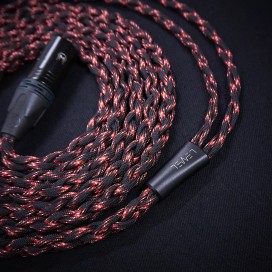
In StockArachne Audio Red Panther headphone cable, dual 3.5 mm
€150.00Hand-built OFC cable in the exclusive Red Panther colour, metal splitter with Level Audio logo. Dual 3.5 mm headphone end, amplifier end of your choice.
-
![]() In Stock
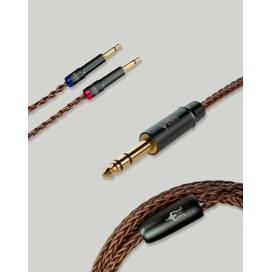
In StockMeze Copper Cable 250 cm, dual 3.5 mm
€349.00Braided Furukawa PCUHD cable with 140 conductors at 0.04mm, with a termination of choice.
-
![]() In Stock
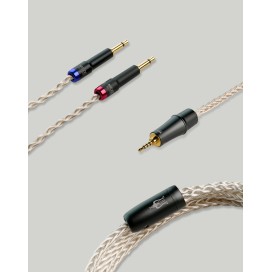
In StockMeze Silver Cable 130 cm, dual 3.5 mm
€399.00Braided Furukawa silver-plated cable with 140 conductors at 0.04mm each, with termination of choice.
-
![]() In Stock
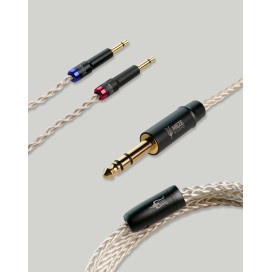
In StockMeze Silver Cable 250 cm, dual 3.5 mm
€499.00Braided Furukawa silver-plated cable with 140 conductors at 0.04mm each, with termination of choice.




Headphone connector
2× Mini-XLR
-
![]()
- New
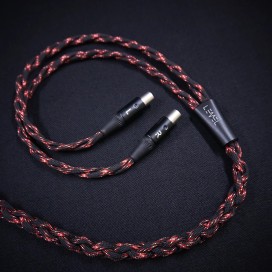
In StockArachne Audio Red Panther headphone cable, dual 4-pin mini-XLR
€150.00Hand-built OFC cable in the exclusive Red Panther colour, metal splitter with Level Audio logo. Dual 4-pin mini-XLR headphone end, amplifier end of your choice.
-
![]() In Stock
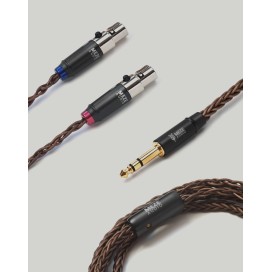
In StockMeze Copper Cable 250 cm, mini-XLR
€349.00Braided Furukawa PCUHD cable with 140 conductors at 0.04mm, with a termination of choice.
-
![]() In Stock
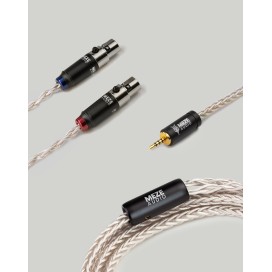
In StockMeze Silver Cable 130 cm, mini-XLR
€399.00Braided Furukawa silver-plated cable with 140 conductors at 0.04mm each, with termination of choice.
-
![]() In Stock
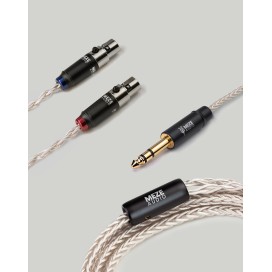
In StockMeze Silver Cable 250 cm, mini-XLR
€499.00Braided Furukawa silver-plated cable with 140 conductors at 0.04mm each, with termination of choice.




Headphone connector
Sennheiser 2-Pin
-
![]()
- New
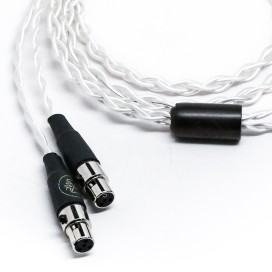
Delivery in approx. 4–6 weeks (handcrafted to order)ZMF Michanikós Headphone Cable
€299.00ZMF Michanikós – ZMF’s first cable with silver content: silver-plated 5N OCC copper in a dedicated 133-strand pattern with an inner insulator strand. Headphone and amplifier plugs to choose, lengths from 1.2 to 3.7 m, made to order by ZMF.

Guide
Which connector do my headphones have?
This overview summarises the specifications of the headphones we carry. What counts is the socket on the earcup; you choose the plug for your amplifier (depending on the cable 2.5 mm, 3.5 mm, 4.4 mm, 6.35 mm or 4-pin XLR) on the cable’s product page under “Amplifier plug”.
| Headphone connector | Headphones in our range | Cables in this category |
|---|---|---|
| 2× 3.5 mm | Headphones: Abyss Diana and JOAL, Focal Clear MG and Stellia, HEDDphone 2, 2 GT and D1, Hifiman Ananda, Arya, Edition XV, HE1000, HE6, HE600 and Susvara, Meze 99 Classic, 105, 109 Pro, Liric II and Strada | Cables: Arachne Red Panther, Meze silver cable 130 cm and 250 cm, Meze copper cable 250 cm |
| 2× Mini-XLR | Headphones: Audeze LCD-2, LCD-3, LCD-4z, LCD-5S, LCD-X, LCD-XC, LCD-MX4 and MM-500, Meze Arta, Elite and Empyrean II, all ZMF models (Atrium, Auteur, Bokeh, Caldera, Ori, Tessidera) | Cables: Arachne Red Panther, Meze silver cable 130 cm and 250 cm, Meze copper cable 250 cm |
| Sennheiser 2-Pin | Headphones: Sennheiser HD 600, HD 650, HD 660 S2 | Cables: none at present |
| 2× ODU | Headphones: Sennheiser HD 800 S, HD 820 | Cables: none at present |
| 2× Hirose | Headphones: DCA E3, Expanse, Noire X, Noire XO, Stealth | Cables: none at present |
| 2× LEMO | Headphones: Focal Utopia | Cables: none at present |
Electrostatic headphones, wireless models, complete systems, in-ears and headphones with a single-sided cable are not listed. The same connector type does not always mean full compatibility, for example with deeply recessed sockets. If in doubt, or for connectors without a cable in this category, just ask us on WhatsApp or via the contact form.
What makes a high-quality headphone cable?
A good high-end headphone cable is about more than the most exclusive conductor material possible. What matters is the interplay of conductor quality, cable geometry, connectors, workmanship and mechanical properties.
High-quality cables use, for example, oxygen-free copper, particularly pure copper or silver-plated conductors. A carefully designed cable geometry and solid contacts ensure reliable signal transmission. The mechanical execution is just as important, however: the cable should be flexible enough to go largely unnoticed while listening, and should neither be unnecessarily heavy nor put strong pull on the headphones.
With high-quality headphones in particular, the quality of the connectors also plays an important role. Precisely manufactured plugs, stable transitions and clean strain relief increase not only reliability but also the service life of the cable.
A good headphone cable is therefore not automatically the most expensive or technically elaborate model, but above all one that suits the respective headphone setup electrically, mechanically and practically.
When is a new high-end headphone cable worthwhile?
Replacing the stock headphone cable can make sense for a variety of reasons. A change in sound is not always the main concern.
A new cable is a good idea, for example, when the original cable:
- is too short or unnecessarily long for the listening position,
- is relatively stiff or heavy,
- tends to microphonics or distracting handling noise,
- lacks a suitable connector for the amplifier in use,
- does not allow the desired balanced connection, or
- needs to be replaced after long use.
For many headphone enthusiasts, feel and everyday usability are also important reasons to switch. A lighter and more flexible cable can noticeably improve comfort, especially during longer listening sessions.
Sonic differences are also discussed with high-quality headphone cables and are sometimes deliberately used by manufacturers for tuning. How clearly such differences are perceived, however, depends on the cable, the headphones, the amplifier and, not least, individual listening impressions. A cable should therefore not be chosen solely on the basis of a particular material.
Finding the right headphone cable for headphones and amplifier
Before buying a high-end headphone cable, first clarify which connectors are needed on both ends. Both the headphones and the headphone amplifier must be compatible with the chosen cable variant.
Headphone-side connectors and compatibility
Many high-quality headphones have detachable cables. The connectors used, however, sometimes differ considerably.
Depending on manufacturer and model, for example 2× 3.5 mm connectors, mini-XLR plugs or proprietary connection systems are used. Even visually similar connectors are therefore not necessarily compatible with one another.
At Level Audio you will find, for example, cable variants for numerous models from Focal, HiFiMAN, Meze, Audeze and ZMF; the overview above shows which connector your model uses. Before ordering, however, it is always advisable to check the specific compatibility with your own headphone model.
6.35 mm, 4.4 mm Pentaconn or XLR at the headphone amplifier?
Various connectors are also available on the amplifier side. The most common variants include:
- 3.5 mm jack
Widespread above all on mobile devices and compact DAC/amp solutions. - 6.35 mm jack
The classic connector of many desktop headphone amplifiers and hi-fi components. - 4.4 mm Pentaconn
A compact balanced connector that is increasingly common on both portable and desktop devices. - 4-pin XLR
An established balanced connector on many high-quality desktop headphone amplifiers.
Which connector makes sense depends on the device at hand. Anyone using a new high-end headphone amplifier or planning to switch should therefore also consider the available outputs.
Balanced or unbalanced headphone cables?
A common question with high-quality headphone cables concerns the difference between balanced and unbalanced connections.
With an unbalanced connection, the left and right channels usually share a common return conductor. With a balanced headphone connection, on the other hand, both channels are routed completely separately.
Connectors such as 4.4 mm Pentaconn or 4-pin XLR enable a balanced connection, provided both headphones and amplifier are designed accordingly.
Importantly, however: a balanced connection is not automatically superior in sound. What matters is how the respective amplifier is constructed. Some devices deliver more power at the balanced output or are fully balanced in design. With other amplifiers, the practical difference is much smaller.
Anyone able to choose between several cable variants should therefore be guided less by the connector type itself than by the design and technical characteristics of the amplifier in use.
Copper, silver-plated conductors and cable construction
The conductor material is one of the most frequently discussed characteristics of a high-end headphone cable.
High-quality cables are made from, among others, OFC copper, particularly pure copper or silver-plated copper. Manufacturers combine these materials with different conductor cross-sections, strand structures and cable geometries.
Copper is used particularly often in the high-end sector because of its very good conductivity and reliable workmanship. Manufacturers sometimes use especially pure grades of copper such as PCUHD or specially selected OFC conductors.
With silver-plated cables, a copper conductor is additionally coated with a thin layer of silver. Such constructions are deliberately offered as an alternative to pure copper cables and are sometimes described as having a slightly different sonic tuning.
A blanket rule such as “silver sounds brighter” or “copper sounds warmer” falls short, however. The conductor material is only one component of the overall cable construction. Geometry, conductor cross-section, connectors and the construction of the cable as a whole also play a role.
Accordingly, the choice should not be made on the basis of a single material alone.
Length, flexibility and workmanship: what really counts in everyday use
Practical properties are often underestimated when choosing a headphone cable. In daily use, however, they have a major influence on listening comfort.
A cable for a fixed listening position, for example, may be significantly longer than a connection between headphones and a compact desktop amplifier. Too much cable length, on the other hand, quickly leads to the cable lying on the floor or getting caught under the desk.
Flexibility is just as important. A high-quality cable should move as naturally as possible and not constantly fight against its own shape. Very stiff or heavy cables can cause annoying pull with lightweight headphones.
A clean braid can also offer advantages. It contributes to controlled cable routing and can at the same time enable a robust construction.
One example is the headphone cables from Arachne Audio available at Level Audio. The hand-made cables rely on OFC copper and are available in different connector variants and lengths. This allows the cable to be matched precisely to headphones, amplifier and listening position.
Meze Audio also offers various high-quality cable variants, including versions made of particularly pure copper as well as silver-plated variants.
Extend a high-end headphone cable or choose a longer cable straight away?
A headphone cable extension can make sense if the listening position is only occasionally further away from the amplifier or if the existing cable is permanently attached to the headphones.
With headphones with a detachable cable, however, a directly fitting cable in the required length is often the more elegant solution. This avoids an additional plug connection, and the entire cable can be matched precisely to its use in terms of weight, flexibility and length.
Anyone who always listens from an armchair, for example, can choose a longer cable straight away. For a desktop setup, on the other hand, a shorter cable is usually more comfortable.
A high-end headphone cable extension should therefore not automatically be the first solution. What matters is how flexible the existing cable system is and what distance actually needs to be bridged.
Discover high-end headphone cables at Level Audio
The ideal headphone cable should suit the entire setup of headphones, amplifier and listening position. Price or a particular conductor material alone are not a reliable yardstick.
Therefore pay particular attention to the headphone-side connector, the desired amplifier output, the right cable length, and workmanship and flexibility that match your listening habits.
At Level Audio you will find selected high-end headphone cables for different headphones and connection systems: from a flexible replacement for the stock cable to a balanced connection via 4.4 mm Pentaconn or 4-pin XLR.
The result is not an arbitrary “cable upgrade”, but a connection that suits your headphone setup precisely, both technically and practically.
FAQ: Frequently asked questions about high-end headphone cables
What is a high-end headphone cable?
A high-end headphone cable is characterised above all by high-quality conductors, precise connectors, clean workmanship as well as good flexibility and durability.
Does a high-end headphone cable improve the sound?
Sonic differences are described differently by manufacturers and listeners. How pronounced they are depends on the overall setup and individual listening impressions.
Which headphone cable fits my headphones?
The connector on the headphones is decisive. Depending on the model, for example 2× 3.5 mm, mini-XLR or manufacturer-specific connection systems are used.
Which is better: 4.4 mm Pentaconn or 4-pin XLR?
Both connectors can be used for a balanced connection. Which variant makes more sense depends primarily on the connectors and the design of the headphone amplifier in use.
Is a balanced headphone cable automatically better?
No. Depending on the amplifier, a balanced connection can offer advantages such as higher output power, but it is not fundamentally superior in sound.
Is copper or silver-plated copper better for headphone cables?
Both materials are suitable for high-quality headphone cables. The conductor material alone, however, does not determine quality. Cable geometry, cross-section, connectors and workmanship are also relevant.
How long should a headphone cable be?
The ideal length depends on the listening position. Shorter cables are usually sufficient for desktop setups, while longer variants can be more practical for an armchair further away.
Can I extend a high-end headphone cable?
Yes, provided the connectors and plugs are compatible. With headphones with a detachable cable, however, a cable of sufficient length is often the more elegant solution.
Can I use any headphone cable with any headphone amplifier?
No. Both the connector on the headphones and the output of the amplifier must match the respective cable variant. Compatibility on both ends should therefore be checked before buying.