At a glance
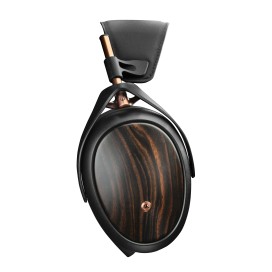
A new version of the revolutionary AMT (Air Motion Transformer) from the HEDDphone 1, together with reduced weight and improved ergonomics: a combination that truly takes the HEDDphone to the next level.
At a glance
Lighter, better, smaller, clearer
The HEDDphone TWO is the result of three years of focused research and development driven by user feedback. Every aspect of the original HEDDphone has been refined to deliver an even more precise and comfortable listening experience.
Ultra-light materials and an improved suspension system allow individual adjustment of height, width, curvature, and clamping force. At the same time, the Air Motion Transformer has been further optimized to deliver a more vivid, lifelike, and natural sound.
The result is a HEDDphone that is lighter, more adaptable, and sonically more convincing than ever before.
Conventional drivers move air back and forth, producing pressure at a 1:1 ratio relative to diaphragm speed. An AMT driver works like an accordion, moving air by squeezing and expanding it at a 4:1 ratio.
This results in an extremely fast transducer with outstanding high-frequency resolution, exceptional transient response, and remarkable clarity.
HEDD Audio explains the concept here:
| Design | Open-back, over-ear |
| Driver | AMT with full-range VVT® technology |
| Frequency range | 10 Hz – 40 kHz |
| Maximum SPL | 89 dB SPL @ 1 mW |
| Impedance | 41 Ω (flat) |
| Power requirement | Min. 200 mW, recommended ≥ 1000 mW |
| Connection | 3.5 mm jack |
| Cable | Kevlar-reinforced, braided |
| Pads | Faux leather ear pads and head cushion |
| Weight | 550 g |
Frequency response
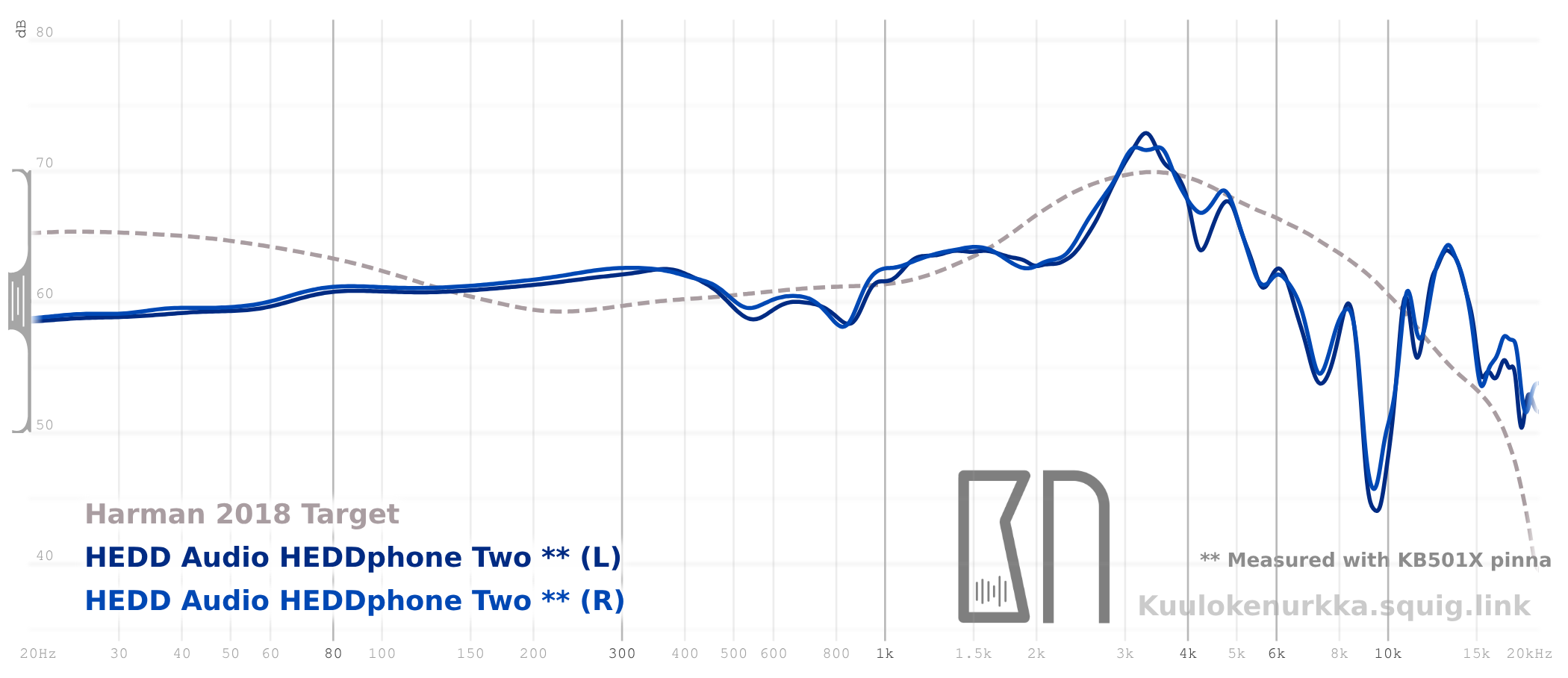
The line marked as target is something you could call the “ideal” curve: a target response derived from research by the Harman group, exploring what kind of headphone tuning tends to be preferred by a broad range of listeners – regardless of age or demographics. This is often referred to as the Harman Target.
From left to right you see sub-bass, bass, mids, and then the curve tilts upward where treble begins. That part of the spectrum is naturally amplified by the shape of the human ear.
Sub-bass sits far below the target – common for open headphones, the Harman target includes a strong bass shelf, the bass follows the target curve. The lower mids are neutral, the presence region around 3 kHz sits slightly below the target. The treble is strongly tuned more relaxed – never sharp, easy over long sessions, above 10 kHz there is a little extra air. Left and right channels track each other closely, a sign of careful driver matching.
Harman Research: The Perception and Measurement of Headphone Sound Quality – What Do Listeners Prefer?