

At a glance
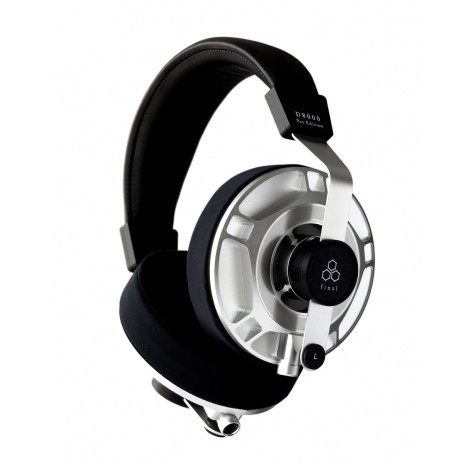
Final Audio D8000 Pro Edition with AFDS technology delivers exceptional clarity, precision and dynamics – handcrafted in Japan.
At a glance
Planar magnetic headphones
With the Final Audio D8000 Pro Edition, Final takes its planar-magnetic reference to the next level. Built around AFDS (Air Film Damping System), it blends the deep, controlled bass associated with dynamic headphones with the finesse and precision of planar drivers. Compared to the standard D8000, the Pro Edition offers a clearer, more direct presentation—ideal for rock, pop, and modern productions.
AFDS – a revolution in planar drivers
The Air Film Damping System controls diaphragm movement via an ultra-thin air film, preventing contact between the diaphragm and the magnets. This makes deep, open bass possible even in an open-back design. The ultra-light aluminum diaphragm (about one-third lighter than typical dynamic diaphragms) delivers outstanding treble resolution and speed.

Sound character & use case
The D8000 Pro Edition delivers a tight, lively signature with clear mids and well-defined treble. While the standard D8000 excels with classical music, the Pro Edition is tuned for modern genres—with more presence and upper-band energy.
Design & precision
The aluminum-magnesium construction is manufactured to extremely tight tolerances, while the leather wrap absorbs minute resonances. Almost all parts are screwed together—easy to service. Made in Kawasaki, Japan using in-house tooling and strict quality control.
Cables & accessories
Included are two detachable OFC cables (1.5 m with 3.5 mm plug and 3 m with 6.3 mm plug, both with locking mechanism) plus a hard carrying case. Open, breathable ear pads ensure long-term comfort. The D8000 Pro Edition is a showcase of Japanese engineering.
| Housing | Aluminum-magnesium alloy |
| Drivers | AFDS planar magnetic |
| Cable | OFC copper |
| Sensitivity | 98 dB/mW |
| Impedance | 60 Ω |
| Weight | 523 g |
| Cable length | 1.5 m / 3 m |
Frequency response
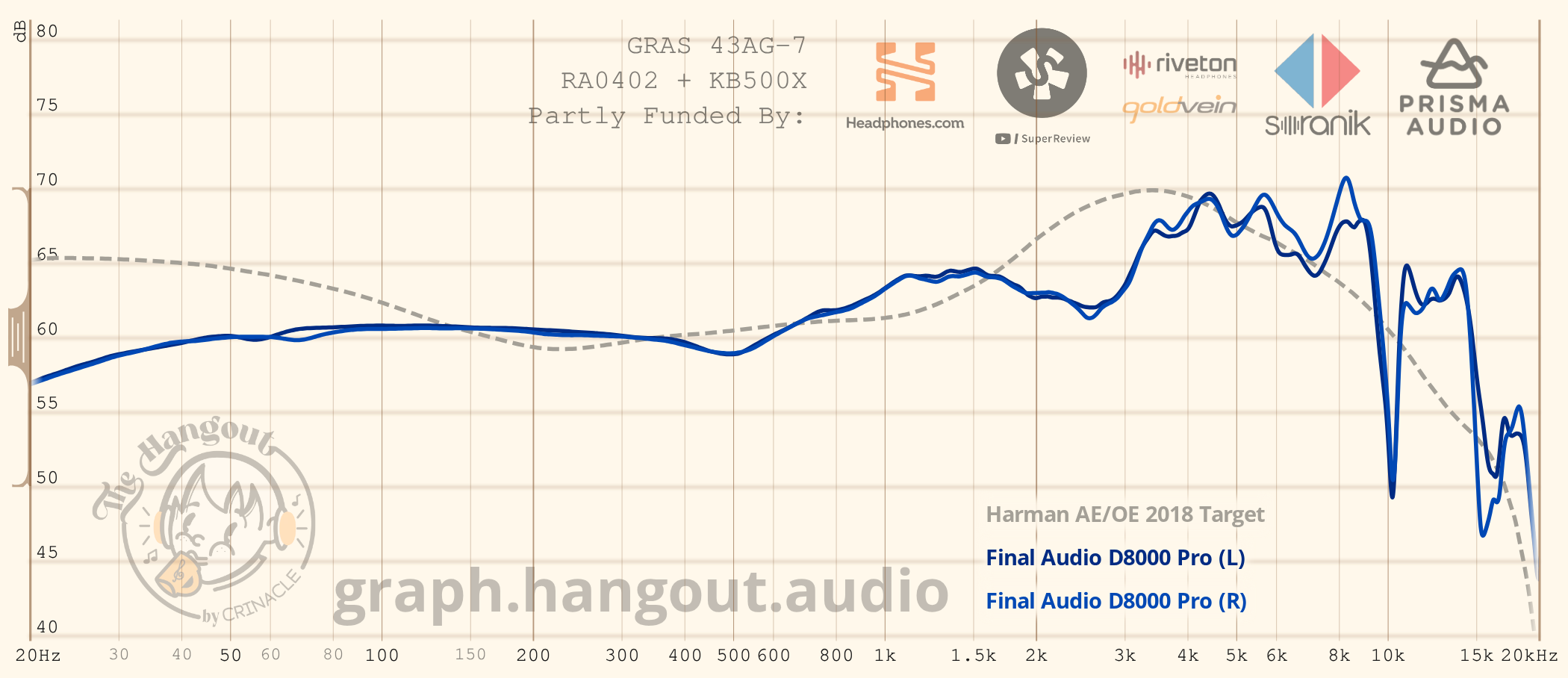
The line marked as target is something you could call the “ideal” curve: a target response derived from research by the Harman group, exploring what kind of headphone tuning tends to be preferred by a broad range of listeners – regardless of age or demographics. This is often referred to as the Harman Target.
From left to right you see sub-bass, bass, mids, and then the curve tilts upward where treble begins. That part of the spectrum is naturally amplified by the shape of the human ear.
Sub-bass sits clearly below the target – common for open headphones, the Harman target includes a strong bass shelf, the bass follows the target curve. The lower mids are neutral, the presence region around 3 kHz sits slightly below the target. The treble is slightly emphasised – that adds detail but can also sound sharper, above 10 kHz there is a lot of extra air. Left and right channels track each other closely, a sign of careful driver matching.
Harman Research: The Perception and Measurement of Headphone Sound Quality – What Do Listeners Prefer?