

At a glance
- Design
- Open
- Driver
- Dynamic
- Impedance
- 32 Ω
- Sensitivity
- 100 dB/mW
- Headphone connector
- 2× 3.5 mm
- Amplification needs
- Low – phone or dongle is enough
HEDDphone D1
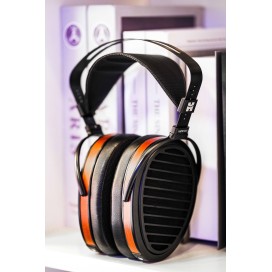
HEDDphone D1 – dynamic high-end headphone with Thin-Ply Carbon Diaphragm, hand-built in Berlin, neutral, detailed and uncompromisingly precise.
- ✓ Authorized Dealer · Original Warranty
- ✓ 30-day returns · Free return shipping within the EU
- ✓ Shipping: free to Italy · EU €19, free from €400
- ✓ Installment Payment Available
- Your legal guarantee rights
Also available as a set
-
The Beginning: JDS Labs Element IV + HEDDphone D1 + Synapse
together with JDS Labs Synapse + JDS Labs Element IV
€1,427.00€1,199.00 You save €228.00 View set →
At a glance
- Design
- Open
- Driver
- Dynamic
- Impedance
- 32 Ω
- Sensitivity
- 100 dB/mW
- Headphone connector
- 2× 3.5 mm
- Amplification needs
- Low – phone or dongle is enough
Why we recommend it
A dynamic headphone developed in Berlin, with a carbon diaphragm and radically low distortion – honest rather than showy. For under €700 you get a level of precision that normally costs a lot more. Deservedly one of our best-selling headphones.
See all recommendations →HEDD Audio HEDDphone D1
Dynamic Headphone
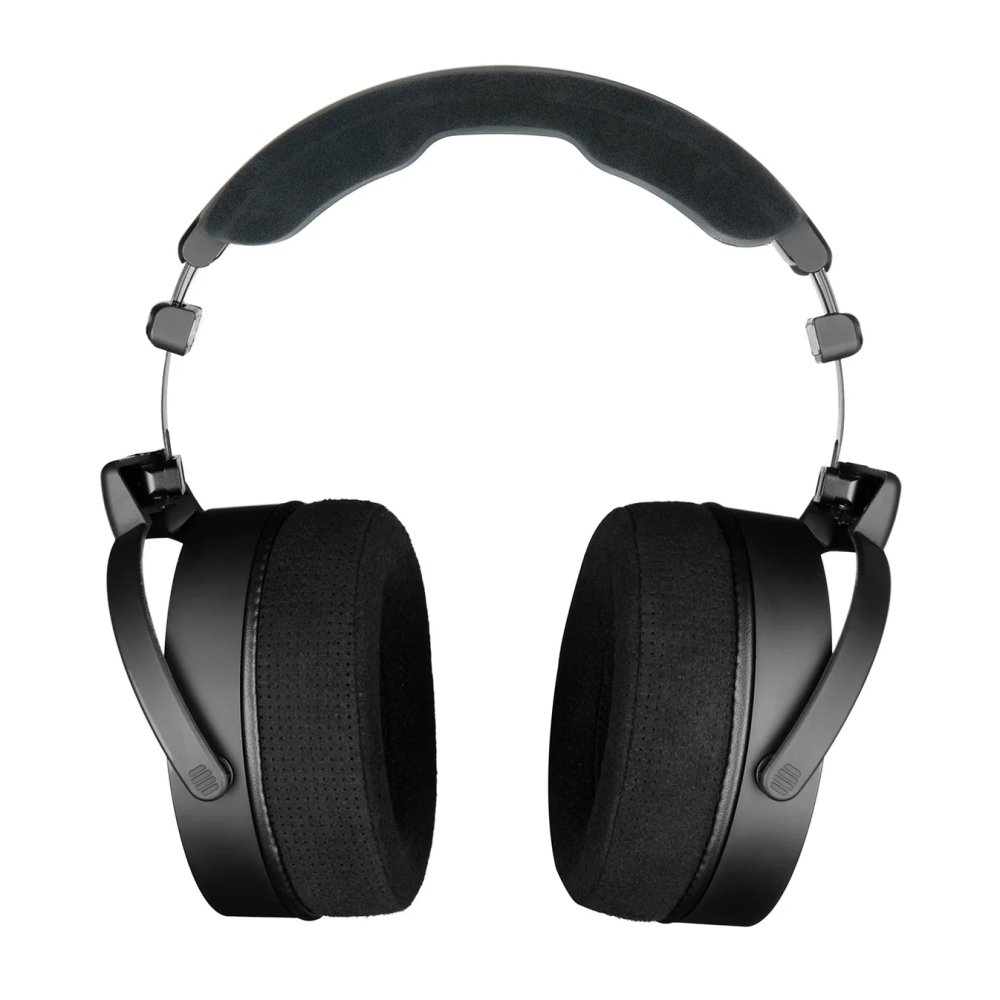
The HEDDphone D1 is HEDD’s new interpretation of what a dynamic headphone can achieve. Designed in Berlin and built for studio professionals and high-end listeners, it combines uncompromising materials with radically low distortion — and a tuning that doesn’t chase effects, but truth.
D1 features Thin-Ply Carbon Diaphragm Technology (TPCD) — an ultra-light diaphragm made from extremely thin, multi-laminated carbon layers. Resonances are controlled so precisely that additional damping material becomes unnecessary. This approach is the key to exceptional clarity, fine detail and tonal neutrality.
Key Features
- Reference-class dynamic headphone with TPCD diaphragm (Thin-Ply Carbon Diaphragm)
- Neutral, natural and highly resolving sound
- Resonance control without additional damping materials
- Precise transients, excellent separation
- Hand-assembled in Berlin, serviceable design
- High comfort, even for long sessions

Thin-Ply Carbon Diaphragm — technology born for extreme scenarios
The diaphragm material is manufactured by Composite Sound in Sweden and comes from technologies used in Formula 1 chassis and demanding aerospace missions. Its strength-to-weight performance is exceptional — enabling linear motion even at high excursions.
The diaphragm moves freely, without “pushing back” from cotton, foam or other padding. That means: faster settling, no damping artifacts, and no swallowed micro-detail.
Neutral, detailed, believable
HEDDphone D1 is not tuned to sound “impressive” — but correct. Treble, mids and bass sit in a natural balance. Transients hit fast without harshness. Bass reaches deep but never turns inflated. Voices keep their body, without “Hi-Fi make-up”.
With 32 Ω impedance and 100 dB sensitivity, D1 works with virtually any playback system — but high-quality amplifiers take it audibly further, with even more spacious separation and more finely rendered harmonic structure.
Ergonomics, long-term comfort, premium feel
Designed for hours-long sessions: balanced pressure distribution, secure fit, no localized hotspots. Materials feel premium, and the construction is serviceable — not a disposable product, but designed with longevity in mind.
Handcrafted in Berlin
The carbon diaphragm comes from Sweden — everything else is made in Berlin and hand-assembled. All components are serviceable, so D1 can be kept in use for the long run. HEDD provides a 5-year warranty.
Technical Specifications
| Design | Open-back over-ear headphone |
| Drivers | Dynamic with Thin-Ply Carbon Diaphragm |
| Frequency Range | 5 Hz – 40 kHz |
| Maximum SPL | 100 dB @ 1 mW |
| Impedance | 32 Ω |
| Pads | Perforated velour |
| Cable | Textile-covered premium cable |
| Inputs | 2 × 3.5 mm |
| Weight | 350 g (net) |
Measurements
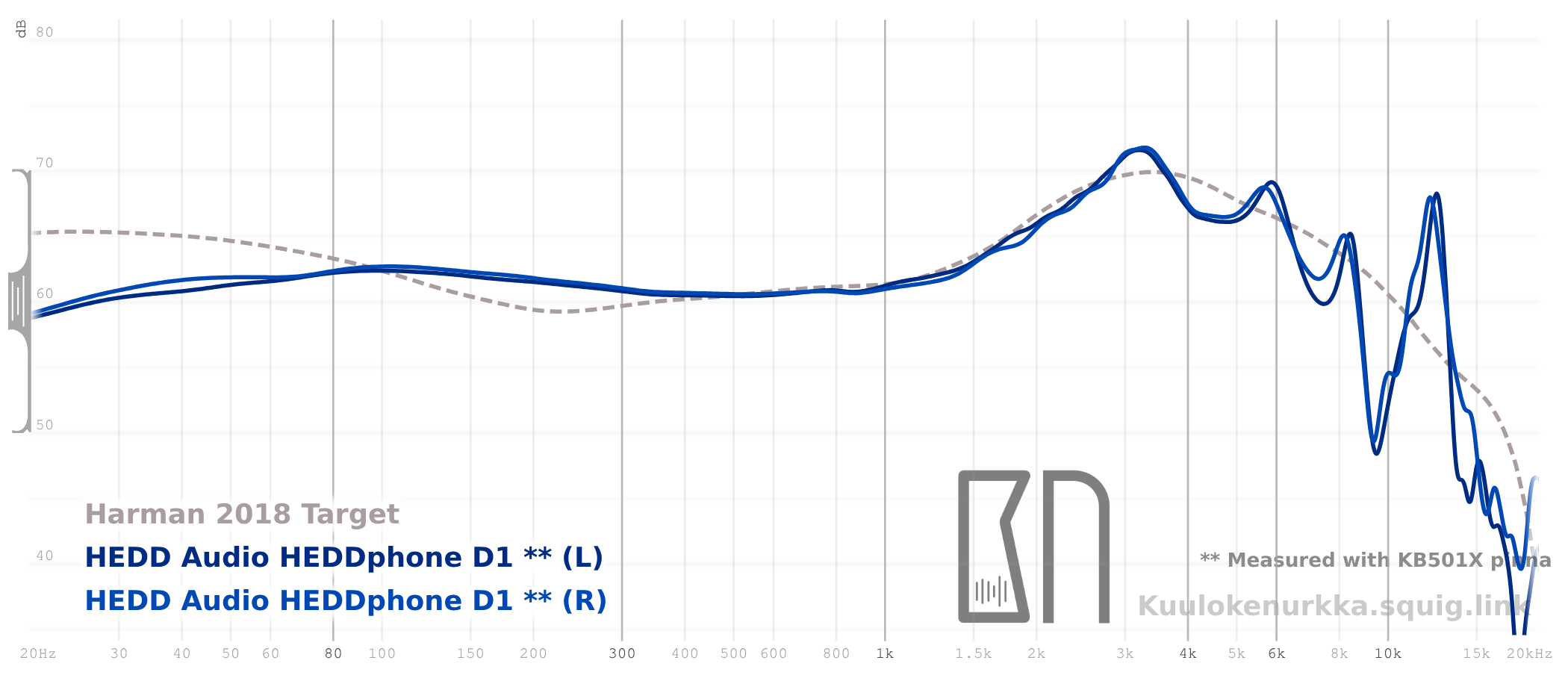
Frequency response
What does this mean?
The line marked as target is something you could call the “ideal” curve: a target response derived from research by the Harman group, exploring what kind of headphone tuning tends to be preferred by a broad range of listeners – regardless of age or demographics. This is often referred to as the Harman Target.
From left to right you see sub-bass, bass, mids, and then the curve tilts upward where treble begins. That part of the spectrum is naturally amplified by the shape of the human ear.
Sub-bass sits clearly below the target – common for open headphones, the Harman target includes a strong bass shelf, the bass follows the target curve. The lower mids are neutral, the presence region around 3 kHz hits the target. The treble is slightly tuned more relaxed – never sharp, easy over long sessions, and the range above 10 kHz stays on the curve. Left and right channels track each other closely, a sign of careful driver matching.
Harman Research: The Perception and Measurement of Headphone Sound Quality – What Do Listeners Prefer?

Data sheet
- Design
- Open
- Driver
- Dynamic
- Impedance
- 32 Ω
- Sensitivity
- 100 dB/mW
- Amplification needs
- Low – phone or dongle is enough
- Headphone connector
- 2× 3.5 mm
- Weight
- 350 g
- Product type
- Headphones