- New


At a glance
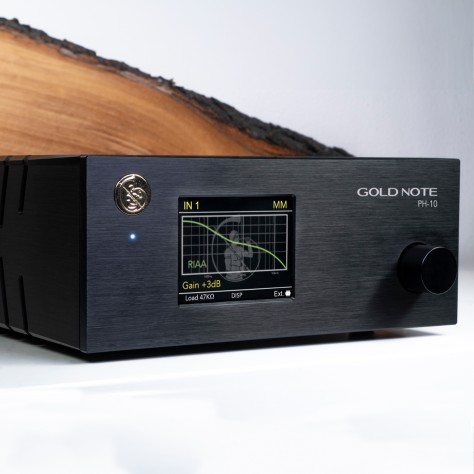
MM/MC phono stage with two separate inputs, nine loading options and three equalisation curves. Everything is set from a single knob and a colour display rather than DIP switches on the back panel.
At a glance
MM/MC phono stage with three equalisation curves
Most phono stages at this price make you commit before you have even heard the thing: MM or MC, with the settings then hidden behind DIP switches on the rear panel. Change cartridge and you take the rack apart.
The PH-10 works differently. It has two entirely separate inputs, so two turntables or two tonearms can stay connected at once, and every adjustment happens on the front knob: gain in four steps from 45 dB for MM up to 65 dB for MC, loading in nine steps from 10 ohms to 47 kilohms. The colour display shows what is set, so you hear a difference and read where it came from at the same time.
There are also three equalisation curves. RIAA has been the standard since 1954, but records cut before then followed other characteristics. Anyone with old Decca or Columbia pressings on the shelf can finally hear them as intended, rather than sending them through an equalisation they were never made for. Each of the three curves is also available in an "Enhanced" variant.
Outputs are balanced on XLR and unbalanced on RCA. The firmware can be updated — the PH-10 has been extended several times over the years, among other things to work with the external PSU-10 power supply.
hi-fi+, Nicholas Ripley, December 2017
„What I got instead was a fast, accurate, and very detailed phono stage that is whisper quiet. That last is key; this is one of the quietest phono stages I have experienced at anything close to this price tag – just the faintest white noise unless you go crazy with the volume control.“
The Audiophile Man, Paul Rigby, September 2018 – rated 8
„An excellent phono amplifier that not only sounds good but also offers a genuinely useful feature set. Well designed and built, easy to use and with a great price point, this phono amplifier offers value for money.“
LB Tech Reviews, Lasse Svendsen, August 2023
„I noted that the PH-10 was largely silent – no audible noise. However, if you turn up the volume a lot, you can hear a faint background noise if you use an MC pickup with a very low output voltage.“
We quote this reservation deliberately: it matches the single criticism raised by AUDIO 9/2018, and it is why we recommend the PSU-10 power supply alongside very low-output MC cartridges.
For anyone who owns more than one cartridge, or expects to before long. The two separate inputs and the front-panel control save you dismantling the system every time. If you run a single MM cartridge and intend to keep it that way, there are cheaper routes to the same result. If you run a very low-output MC, budget for the PSU-10 power supply at the same time — the press agrees that this is exactly where it makes the difference.
| Inputs | 2 × RCA, independent, MM and MC |
| Input sensitivity | 0.1 mV (MC) to 10.0 mV (MM) |
| Gain | 45 dB (MM) to 65 dB (MC), 4 steps: 0 dB, ±3 dB, +6 dB |
| Loading | 9 steps: 10, 22, 47, 100, 220, 470, 1000 Ω, 22 kΩ, 47 kΩ |
| Input capacitance | 220 pF (MM only) |
| EQ curves | RIAA, Decca London, American Columbia – each also Enhanced |
| Outputs | 1 × RCA unbalanced, 1 × XLR balanced (+12 dB) |
| Output impedance | 50 Ω |
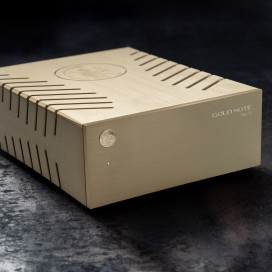
| Power supply | Super Linear, internal; upgradeable with Gold Note PSU-10 |
| Power consumption | 10 W |
| Dimensions | 200 × 80 × 260 mm (W × H × D) |
| Weight | 3 kg |
| Finishes | Black, silver, gold – anodised and brushed aluminium |
| Made in | Tuscany, Italy |