- New


At a glance
RME ADI-2/4 Pro EX: the flagship of the ADI-2 series – AD/DA converter, DAC and headphone amplifier with ESS converters, balanced 4.4 mm Pentaconn output, phono mode and DSD256.
At a glance
The flagship of the ADI-2 series: AD/DA converter, DAC and headphone amplifier with phono mode and a balanced 4.4 mm output
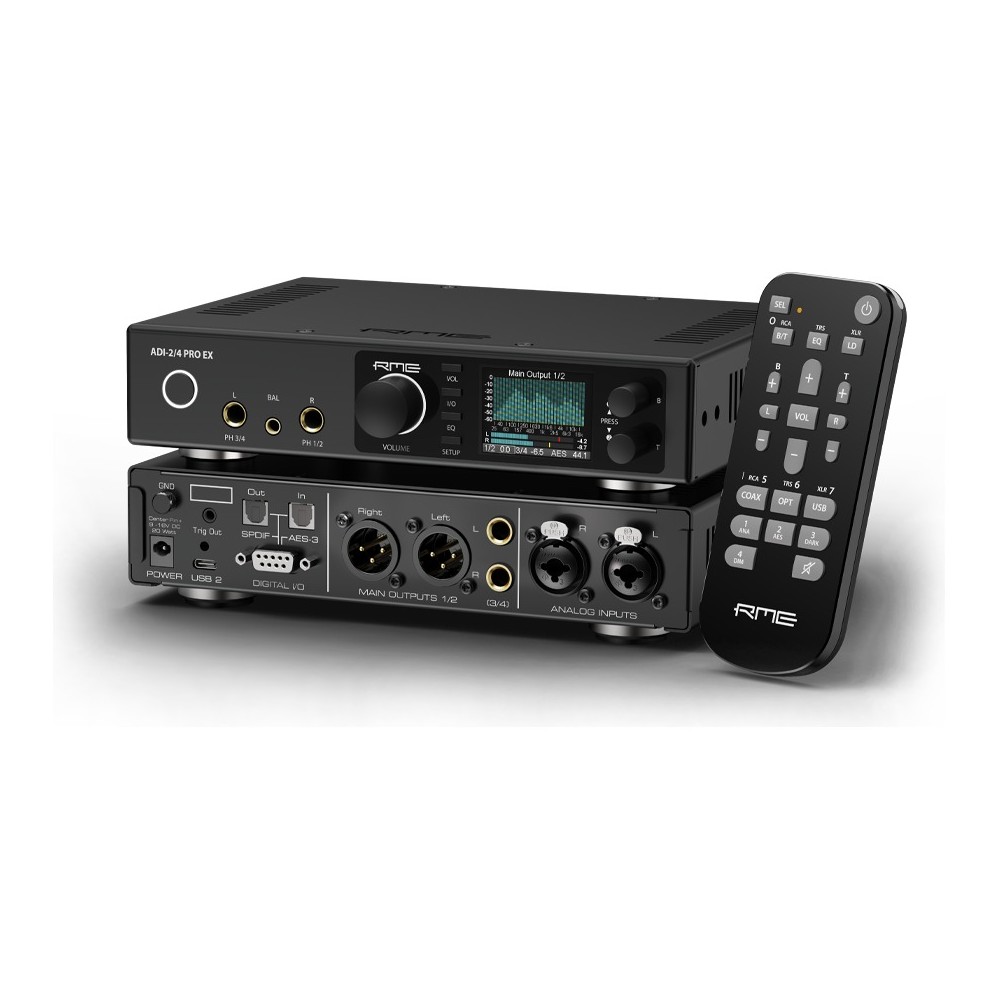
The ADI-2/4 Pro EX is the new top model of RME’s ADI-2 series. Like the ADI-2 Pro EX, it combines a studio-grade AD/DA converter, a DAC, a preamplifier, two headphone amplifiers and a USB audio interface in a chassis measuring 21.5 × 16 cm. The name describes the layout: two analogue input channels and four output channels, spread across two independent stereo converters.
RME describes the EX version as a refined development of the ADI-2/4 Pro Special Edition. The main additions are ESS converter chips, a balanced headphone output on a 4.4 mm Pentaconn socket, a phono mode for turntables with MM cartridges and a more precisely calibrated clock. On top come the improvements of the whole EX series: a lockable USB-C port, a 12 V trigger output, channel-independent DC protection on the headphone outputs and a power input protected against reverse polarity and overvoltage.

For analogue-to-digital conversion RME uses the ESS ES9823PRO. At the analogue input the ADI-2/4 Pro EX reaches up to 125 dB (AES17) or 127 dBA signal-to-noise ratio and distortion below −127 dB. According to the manual, the noise of this converter does not rise up to 100 kHz, which also makes it suitable for measurement work. Digital-to-analogue conversion is handled, according to RME’s distributor, by the ESS ES9039Q2M. At the XLR outputs RME measures 126 dBA signal-to-noise ratio and distortion below −130 dB.
The unit handles PCM at up to 32 bit and 768 kHz and DSD up to DSD256 (11.2 MHz) for both recording and playback. The entire circuit is balanced and DC-coupled. The only capacitors in the signal path sit directly at the input.
The PH 3/4 headphone output has its own stereo converter and works completely independently from the rear outputs, with its own source, volume and equaliser. PH 1/2 shares its signal with the line outputs but uses the same Extreme Power output stage. This lets you drive two headphones at once or compare them directly at matched volume.
As soon as a headphone is plugged into the 4.4 mm Pentaconn socket, the ADI-2/4 Pro EX switches to balanced operation. It then delivers up to 3.85 W into 32 Ω and 1.15 W into 300 Ω per channel, with a maximum level of 18.4 V. Unbalanced, it provides up to 2.4 W into 32 Ω. A dedicated IEM setting looks after sensitive in-ear monitors. All headphone outputs have relays plus overcurrent and DC protection, and the volume ramps up slowly after a plug is inserted.

New to the Pro line is a phono mode for MM cartridges. Input impedance, RIAA equalisation and preamplification are built in, so an external phono preamplifier is no longer needed. You choose the gain in six steps between 0 and +38 dB, and according to RME the deviation from the RIAA curve stays below ±0.05 dB. Because the equalisation is done digitally, phono mode runs with PCM up to 192 kHz. The turntable connects via two RCA-to-jack adapters, its ground wire to the ground screw on the rear. At the 0 dB setting you can add an external preamplifier for MC cartridges, and the ADI-2/4 Pro EX then only handles the equalisation.
The two servo-balanced inputs on XLR/TRS combo sockets can be set to five analogue reference levels from +1 to +24 dBu. Digitally, sensitivity extends down to −35 dBu, so even dynamic microphones can be connected directly. On the rear you find two XLR outputs with up to +26.5 dBu and two TRS outputs that carry either outputs 1/2 or 3/4, for example to insert an external processor during mastering.
Digital connectivity covers AES/EBU, coaxial and optical SPDIF and ADAT, plus a sample rate converter. Over USB the unit works in stereo mode at up to 768 kHz or in multichannel mode with 6 inputs and 8 outputs, including with an iPad. With SteadyClock EX, the internal clock of every unit is factory-calibrated to ±1 ppm and can be fine-tuned in steps of 0.1 ppm. A 12 V trigger output switches power amplifiers or active speakers on and off together with the unit.
The built-in DSP offers a 5-band parametric equaliser for inputs and outputs, bass and treble, volume-dependent loudness, crossfeed for headphones and M/S processing. Everything can be switched off and saved as a setup. The IPS display shows levels, a 30-band analyser and the status of all inputs. You operate the unit with three encoders and four buttons, the supplied remote control or the ADI-2 Remote software.
For anyone looking for one converter for both studio and living room: for mastering and recording, for digitising records, as a preamplifier for active speakers and as an amplifier for demanding headphones with balanced cables. If you need neither the phono mode nor the Pentaconn socket, the ADI-2 Pro EX offers a very similar feature set at a lower price.
| General and conversion | |
| Device type | 2-channel A/D converter, 4-channel D/A converter, USB audio interface, DAC, preamplifier, headphone amplifier |
| A/D converter | ESS ES9823PRO |
| D/A converter | ESS ES9039Q2M (according to RME’s distributor) |
| PCM | up to 32 bit / 768 kHz |
| DSD | DSD64 to DSD256 (11.2 MHz), recording and playback |
| Clock | SteadyClock EX, internal accuracy ±1 ppm, fine-tunable ±50 ppm |
| Analogue inputs | |
| Connectors | 2 × XLR/TRS combo socket, servo-balanced |
| Input impedance | 94 kΩ balanced, 47 kΩ unbalanced |
| Reference levels | +1, +7, +13, +19, +24 dBu; digital down to −35 dBu |
| Signal-to-noise ratio | up to 125 dB (AES17) / 127 dBA |
| THD / THD+N at −1 dBFS | < −127 dB / −119 dB |
| Channel separation | > 130 dB |
| Phono mode (RIAA) | for MM cartridges, gain 0 to +38 dB in 6 steps, deviation < ±0.05 dB, PCM up to 192 kHz |
| Line outputs | |
| XLR 1/2 | balanced, reference levels +1 to +24 dBu, maximum +26.5 dBu |
| TRS (1/2 or 3/4) | 2 × 6.3 mm, impedance-balanced, maximum +21.5 dBu |
| Signal-to-noise ratio | 124 dB (AES17) / 126 dBA |
| THD / THD+N at 0 dBFS | < −130 dB / −119 dB |
| Headphone outputs | |
| Connectors | 2 × 6.3 mm (PH 1/2, PH 3/4), 1 × 4.4 mm Pentaconn balanced |
| Output impedance | 0.1 Ω, balanced 0.2 Ω |
| Power unbalanced | 2.4 W into 32 Ω, 1.93 W into 16 Ω, 0.288 W into 300 Ω per channel |
| Power balanced | 3.85 W into 32 Ω, 1.93 W into 16 Ω, 1.15 W into 300 Ω per channel |
| Maximum level balanced | +27.5 dBu (18.4 V) |
| Signal-to-noise ratio | up to 126 dBA |
| Digital connections | |
| USB | USB-C (USB 2.0), lockable, Class Compliant; stereo 2 × 2 up to 768 kHz, multichannel 6 × 8 |
| AES/EBU, SPDIF | AES/EBU and coaxial SPDIF via breakout cable, optical SPDIF / ADAT |
| Sample rates | internal 44.1 to 768 kHz, external 32 to 200 kHz |
| Trigger output | 12 V, 3.5 mm jack |
| Power and dimensions | |
| Power supply | external, 100–240 V, 12 V / 40 W, lockable connector |
| Power consumption | 14 W idle, maximum 30 W |
| Dimensions (W × H × D) | 215 × 44 × 160 mm |
| Weight | 1.2 kg |