- -€101.00
- New


At a glance
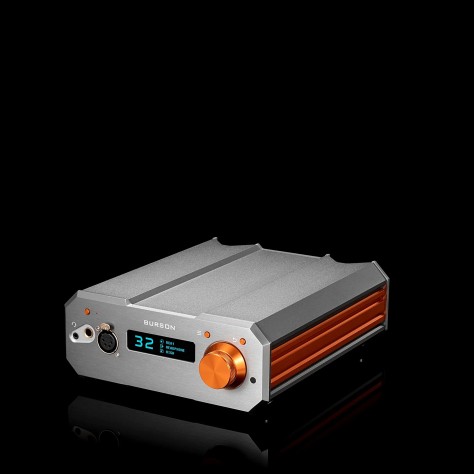
Burson Soloist Stellar: discrete Class A headphone amplifier and preamp with 8 W into 32 Ω via XLR, a dedicated IEM stage and swappable V7 op-amps, available as Deluxe or as Max with the Fusion Core power supply.
At a glance
Compact Class A headphone amplifier and preamp with a dedicated IEM stage
The Soloist Stellar is the compact headphone amplifier from Melbourne-based Burson Audio. It brings the design of the larger Soloist Voyager into a 210 × 200 × 75 mm chassis: discrete, Class A and balanced. It has no DAC, so you connect your DAC or streamer via XLR or RCA. Headphones plug into 4-pin XLR or 6.3 mm, and as a preamp the unit provides XLR and RCA outputs plus a mono subwoofer output.

Burson specifies 8 W into 32 Ω and 1.1 W into 300 Ω via XLR. The Class A stage uses four Onsemi transistors per channel. In-ear monitors get their own stage with two TPA6120A2 amplifier chips (1 W via XLR, 0.5 W via 6.3 mm), so that even sensitive models stay free of hiss. Volume is handled by two analogue PGA2320 resistor ladders, via the knob or the remote control.
The op-amps are socketed. If you want to change the voicing, you can fit other dual types, such as the V7 Classic.

Good to know: Class A generates heat even at idle. HiFiGeek mentions 50 W of idle bias and a chassis that gets warm to the touch. Place the Soloist Stellar in the open rather than in a closed cabinet.
The Max spent three months on the reviewer’s desk in daily use and received the HiFiGeek Award and a reference rating. The review praises the slightly warm tuning combined with high resolution, the control over planars and the IEM mode.
The Deluxe was tested with headphones, IEMs and as a preamp. The review sees it as a miniature Soloist Voyager and highlights its dynamics and resolution at this size and price.
In a direct comparison, the video review puts it at around 85 to 90 % of the Soloist Voyager’s performance for less than half the price. The Voyager remains more transparent and better separated, while the Stellar’s IEM output is completely silent.
For anyone who already owns a good DAC or streamer and wants to run both power-hungry planars and sensitive IEMs from one amplifier. If you also need a DAC, the Conductor Stellar has one built in.
| Amplifier | |
| Design | Class A, discrete, balanced |
| Headphone outputs | 4-pin XLR (balanced), 6.3 mm |
| Power into 32 Ω (XLR / 6.3 mm) | 8 W / 4 W |
| Power into 100 Ω (XLR / 6.3 mm) | 5 W / 2.5 W |
| Power into 150 Ω (XLR / 6.3 mm) | 3.5 W / 2 W |
| Power into 300 Ω (XLR / 6.3 mm) | 1.1 W / 520 mW |
| IEM stage into 32 Ω (XLR / 6.3 mm) | 1 W / 500 mW |
| Gain settings | 2, plus the IEM stage |
| Headphone output impedance | 0.5 Ω |
| Preamp output impedance | 1 Ω / 20 Ω |
| Input impedance | 40 kΩ |
| Distortion (THD) | < 0.0015 % |
| Frequency response | 0–55 kHz (±1 dB) |
| Signal-to-noise ratio | > 105 dB (high gain), > 100 dB (IEM stage) |
| Connections | |
| Inputs | 1× XLR, 1× RCA |
| Outputs | 1× XLR and 1× RCA (preamp), 1× RCA mono (subwoofer) |
| General | |
| Dimensions | 210 × 200 × 75 mm |
| Weight | approx. 5 kg |
| Mains voltage | 100–240 V |
| Power figures | Manufacturer data, high gain |