- New



At a glance
The Warwick Acoustics APERIO GSE combines world-class electrostatic resolution with GoldenSound tuning, natural timbre and breathtaking spatial realism.
At a glance
GoldenSound Signature Edition
When “Endgame” Is No Longer Enough.
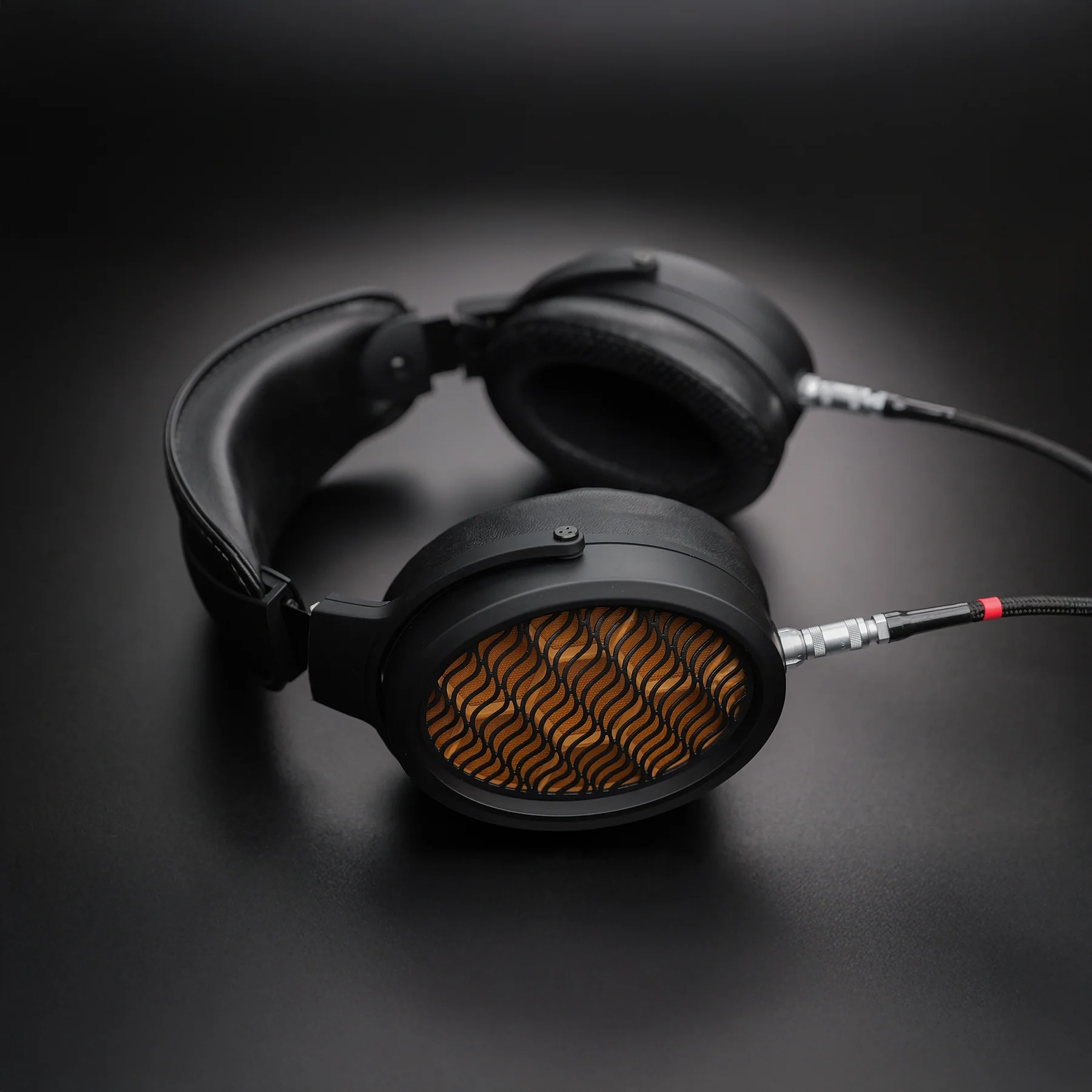
There are headphones that impress. There are reference systems that set new standards. And then there are products for which the usual categories suddenly stop making much sense.
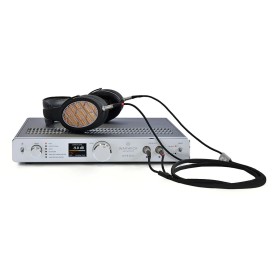
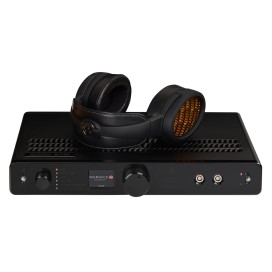
The Warwick Acoustics APERIO GoldenSound Signature Edition belongs firmly in that last category. It is not simply an exceptionally refined electrostatic headphone paired with a matching amplifier. The APERIO GSE is a complete playback system developed from the ground up as a single entity, combining headphones, electrostatic energizer, preamplifier and reference DAC.
Its goal sounds remarkably simple and is extraordinarily difficult to achieve: leave as little as possible between the recording and the listener.
The original APERIO was already regarded as one of the most uncompromising headphone systems ever created. That is precisely what makes the story behind the GSE version so unusual.
After British audio reviewer GoldenSound had spent extensive time listening to the APERIO, an idea emerged together with Warwick Acoustics’ engineers: preserve its extraordinary core capabilities while reconsidering its tonal balance and musical presentation.
The result is neither a simple special edition nor a cosmetic tuning profile added after the fact. For the GoldenSound Signature Edition, the analogue and digital signal paths were retuned and further developed. Combined with Warwick’s latest Gen-2 BD-HPEL technology, this creates a distinct interpretation of the APERIO.
Its enormous transparency and speed remain intact. At the same time, the GSE aims for greater tonal naturalness, more substantial and authoritative bass, and an even more believable spatial presentation.
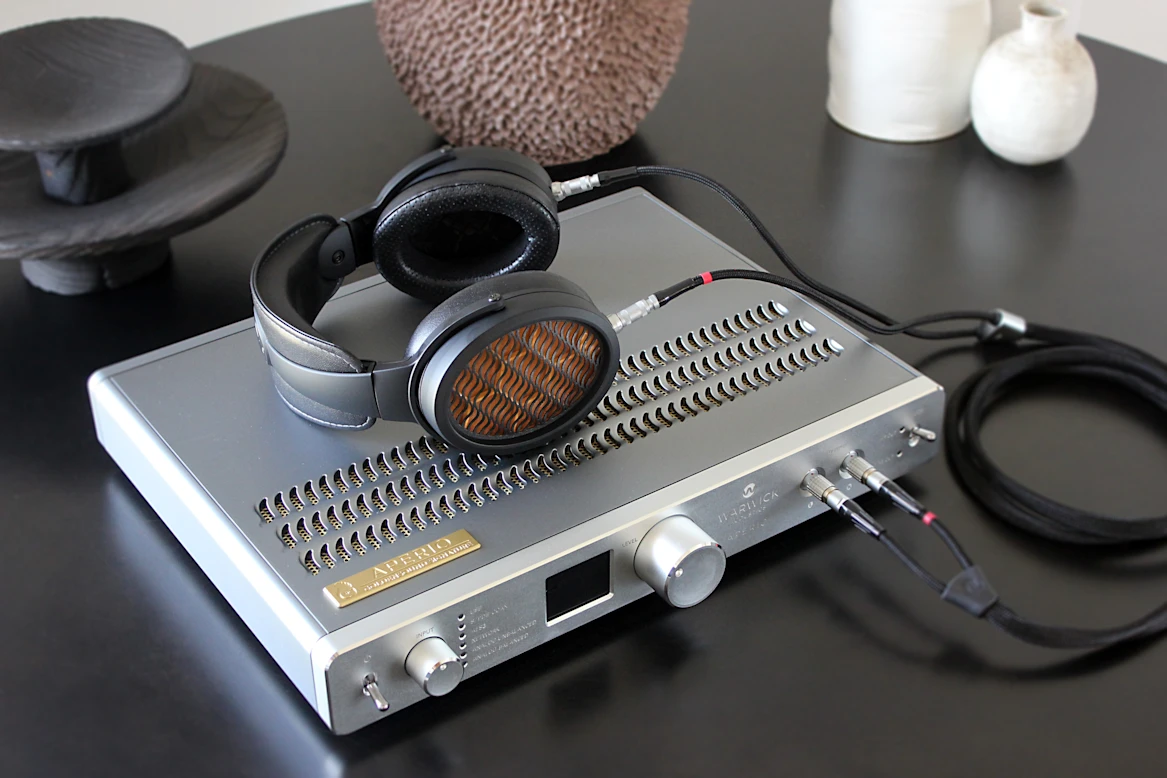
Perhaps the APERIO GSE’s greatest trick is that its extraordinary technical performance never constantly demands your attention.
Resolution is spectacular. Transients appear with virtually no temporal blur. Fine dynamic shifts become effortlessly audible, while individual sonic events can be followed with exceptional precision.
Yet the APERIO GSE does not attempt to make music more impressive by artificially spotlighting detail. Its strength lies in reproducing information, timbre, dynamics and space simultaneously.
The low frequencies reveal particularly clearly where Warwick and GoldenSound have taken the GSE. The bass retains the speed and definition for which electrostatic systems are famous, while sounding remarkably substantial at the same time.
Double basses have body. Large drums have weight. Electronic sub-bass reaches deep without becoming slow or bloated. More important than sheer quantity is the texture: individual bass notes remain clearly separated and their internal structure stays intelligible.
This is where the APERIO GSE begins to make you forget about technical perfection altogether. Voices no longer appear as a perfectly reproduced frequency range, but as real, three-dimensional events in space.
Breath, articulation, chest resonance, the body of a cello or the wood of an acoustic instrument are reproduced with a naturalness that comes remarkably close to the sensation of a genuine acoustic performance.
A system with this level of resolution could easily sound spectacular yet fatiguing. This is precisely where the GSE’s special tuning reveals itself.
Cymbals possess metal, air and natural decay. Reverberation trails can be followed to their final moments. Yet the treble remains coherent and organic. Details do not step outside the music – they belong to it.
The APERIO GSE’s soundstage impresses less through an artificially gigantic effect than through its extraordinary sense of order.
Musicians are not merely positioned left, right or centre. Distance, depth and the relationships between individual sound sources become tangible. Particularly with complex classical recordings, jazz ensembles or exceptionally produced live music, this creates a striking sense of spatial reality.
At the heart of the APERIO lies Warwick’s patented Balanced-Drive High Precision Electrostatic Laminate technology – BD-HPEL for short.
Unlike a conventional dynamic driver, the electrostatic transducer uses an extremely lightweight diaphragm driven across its entire surface. The latest-generation symmetrical Balanced-Drive construction enables high excursion, improved linearity and extraordinarily low distortion.
You hear the benefit precisely where conventional drivers can begin to blur information together: rapid drum sequences, complex orchestral passages, minute changes in level or the natural decay of an instrument.
The APERIO GSE separates these events with remarkable composure. Here, speed does not mean aggression – it means the absence of inertia.
The open earcups are made from magnesium. The material is considerably lighter than aluminium while offering excellent damping characteristics, allowing for an extremely rigid, resonance-resistant structure.
The open design also serves a clear acoustic purpose: only as much material as absolutely necessary surrounds the transducer. Air should be able to move as freely as possible, without unnecessary structures reflecting or storing acoustic energy.
The ear pads combine acoustically optimised foam with premium Cabretta leather. Perforated surfaces and an integrated copper-thread mesh assist heat dissipation – an important detail when a short listening session unexpectedly turns into several complete albums.
Despite its sophisticated construction, the headphone weighs only around 405 grams without cable.
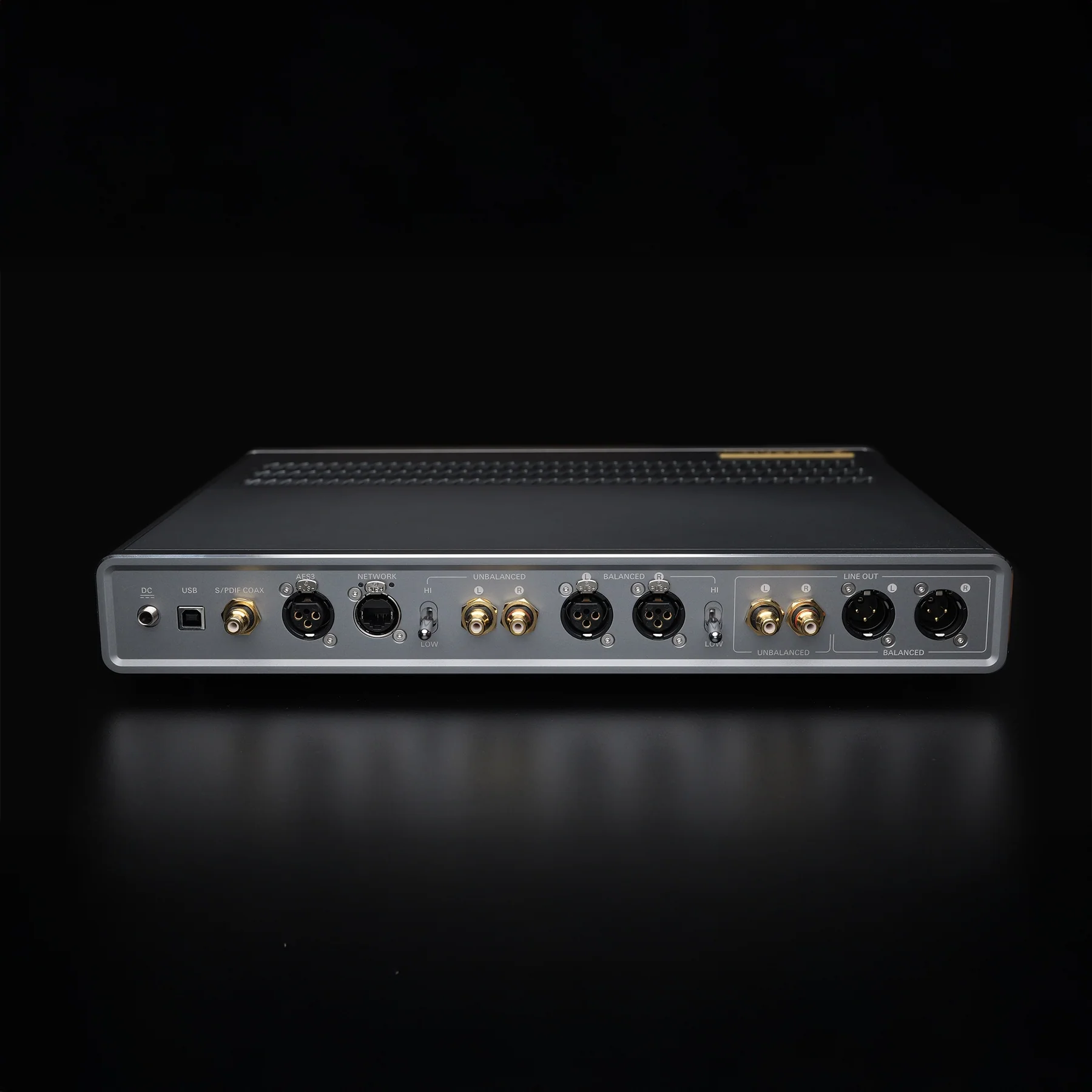
One of the most important differences between APERIO and almost every conventional high-end headphone lies in its system architecture.
With APERIO, you do not buy a headphone first and then begin searching for the right DAC, amplifier, power supply and combination of components.
Warwick develops transducer and electronics together. Output stage, high-voltage supply, volume control, DAC and headphones are matched as one closed system.
This not only eliminates the usual question of amplifier synergy. It gives the engineers control over the entire playback chain.
If you already own an absolute reference DAC or a premium analogue source, APERIO does not force you to give it up.
The analogue inputs are processed through a dedicated analogue signal path. The system can therefore operate either as a complete digital solution or as part of an existing high-end audio chain.
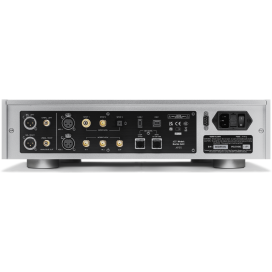
APERIO also features analogue line outputs, allowing it to serve as the central preamplifier of a full-size HiFi system.
On the digital side, APERIO employs an elaborate dual-DAC architecture. Two 32-bit / 8-channel converters provide a signal-to-noise ratio of up to 131 dB.
Via USB and network, the system processes high-resolution PCM up to 32-bit / 384 kHz as well as DSD up to DSD256. AES3 and coaxial S/PDIF are also available.
| Analogue inputs | Balanced XLR, unbalanced RCA |
| Analogue outputs | Balanced XLR, unbalanced RCA |
| USB | PCM up to 32-bit / 384 kHz, DSD up to DSD256 |
| Network | RJ45 Ethernet, high-resolution digital playback |
| AES3 | PCM up to 24-bit / 192 kHz |
| S/PDIF | Coaxial, PCM up to 24-bit / 192 kHz |
What ultimately makes the APERIO GSE so extraordinary is not one particular technical record. It is the way all of its qualities come together.
An APERIO can expose everything contained within a recording with ruthless clarity. Yet the GSE manages to prevent that transparency from becoming an end in itself.
“The Aperio is not just a headphone. It is a complete HiFi system.”
– Audio Essence on the APERIO GSE
That perhaps captures the character of the system better than anything else. The APERIO GSE does not necessarily aim to be the headphone with the biggest bass, the widest stage or the most spectacular treble.
Instead, it attempts to get everything right at the same time – and then get out of the way.
The APERIO GSE does not replace the character of the original APERIO with an entirely different concept. Its fundamental virtues remain: speed, extraordinary resolution, neutrality and exceptionally low distortion.
The GoldenSound Signature Edition does, however, shift the emphasis somewhat further towards naturalness, physicality, spatial depth and long-term musical engagement.
| APERIO | APERIO GSE |
|---|---|
| extremely neutral reference tuning | GoldenSound Signature tuning |
| maximum transparency | transparency with a more substantial tonal balance |
| extremely precise low frequencies | more authoritative and textured bass |
| highly direct presentation | greater emphasis on naturalness and spatial realism |
| Type | Open-back circumaural electrostatic headphone |
| Transducer | Gen-2 Balanced-Drive High Precision Electrostatic Laminate (BD-HPEL) |
| Effective transducer area | 3,570 mm² |
| Frequency range | 10 Hz – 60 kHz |
| Earcups | Magnesium, open construction |
| Ear pads | Cabretta leather, acoustically optimised foam |
| Weight | approx. 405 g without cable |
| System | Electrostatic energizer, headphone amplifier, DAC and preamplifier |
| Architecture | Dual mono, fully differential analogue signal path |
| DAC | Dual 32-bit / 8-channel |
| DAC signal-to-noise ratio | up to 131 dB |
| USB / network PCM | up to 32-bit / 384 kHz |
| DSD | up to DSD256, native or DoP |
| AES3 / S/PDIF | up to 24-bit / 192 kHz PCM |
| Bandwidth | > 65 kHz |
| Distortion + noise | < 0.001% |
| Electronics dimensions | 68 × 413 × 351 mm (H × W × D) |
| Electronics weight | approx. 7.4 kg excluding power supply |
With a product such as the APERIO GSE, the traditional question “Is it worth the price?” eventually loses its usual frame of reference.
This is not about the most sensible upgrade or the best price-to-performance ratio. It is about discovering what becomes possible when a manufacturer treats transducer, amplification, digital technology, mechanics and tuning as one single project, leaving as little room as possible for the usual compromises.
The Warwick Acoustics APERIO GoldenSound Signature Edition is a system for listeners who are no longer asking which headphone represents the next step.
It is for those who want to know
just how far headphone reproduction can go.
Frequency response
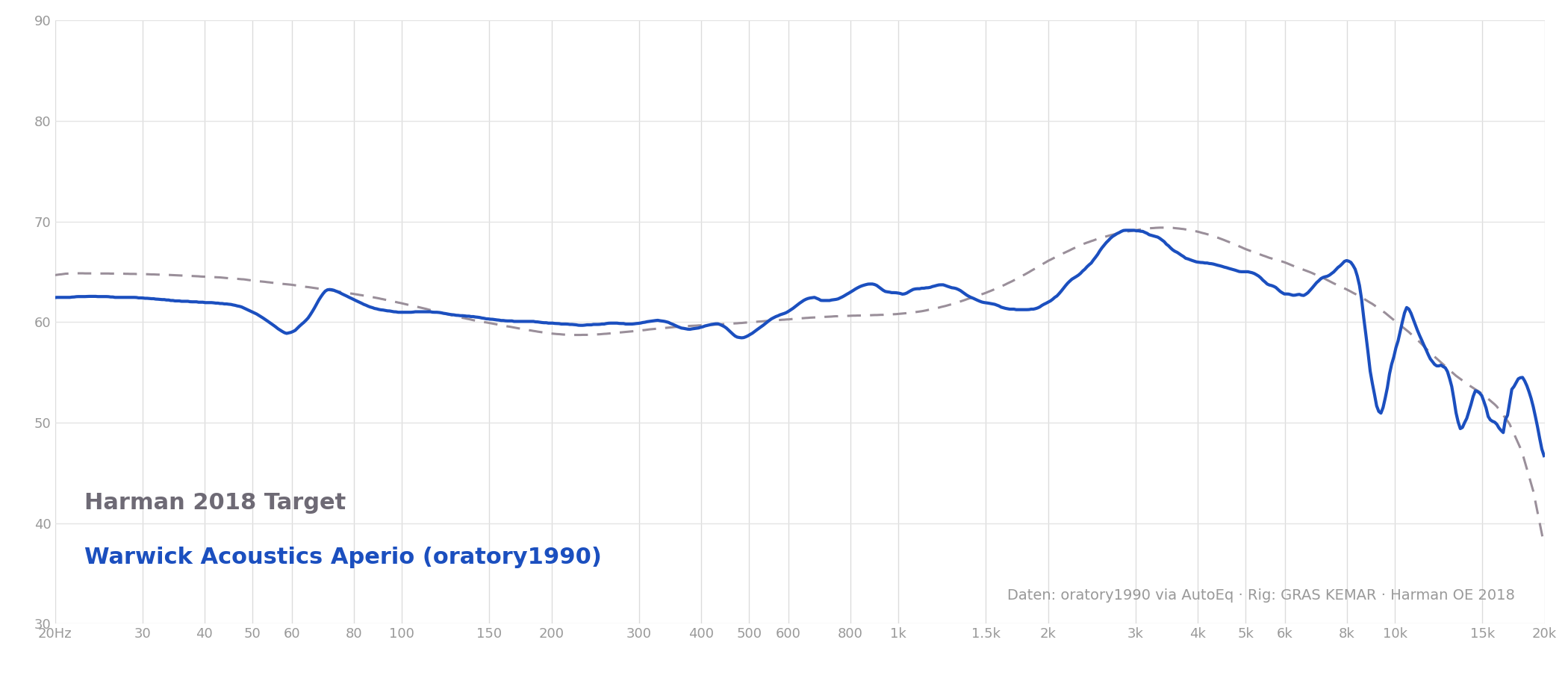
The line marked as target is something you could call the “ideal” curve: a target response derived from research by the Harman group, exploring what kind of headphone tuning tends to be preferred by a broad range of listeners – regardless of age or demographics. This is often referred to as the Harman Target.
From left to right you see sub-bass, bass, mids, and then the curve tilts upward where treble begins. That part of the spectrum is naturally amplified by the shape of the human ear.
Sub-bass sits slightly below the target, the bass follows the target curve. The lower mids are neutral, the presence region around 3 kHz sits slightly below the target. The treble is slightly tuned more relaxed – never sharp, easy over long sessions, and the range above 10 kHz stays on the curve.
Harman Research: The Perception and Measurement of Headphone Sound Quality – What Do Listeners Prefer?