- -€101.00
- New


At a glance
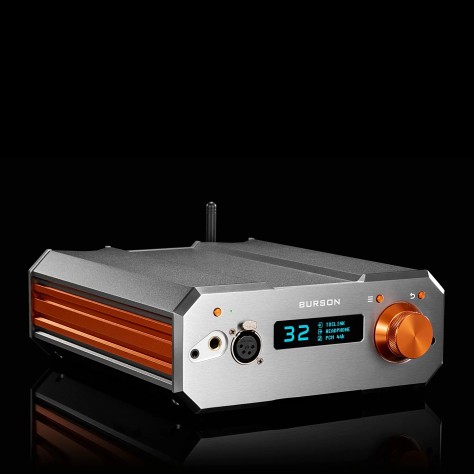
Burson Conductor Stellar: DAC with ESS ES9039PRO, Class A headphone amplifier with 8 W into 32 Ω via XLR and preamp in one compact chassis, with a dedicated IEM stage and Bluetooth, available as Deluxe or as Max with the Fusion Core power supply.
At a glance
Compact DAC and Class A headphone amplifier with ESS ES9039PRO and a dedicated IEM stage
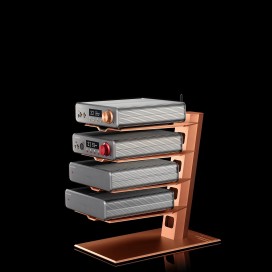
The Conductor Stellar combines a DAC, headphone amplifier and preamp in a 210 × 200 × 75 mm chassis. The amplifier section matches the Soloist Stellar: discrete, Class A and balanced, with 8 W into 32 Ω and 1.1 W into 300 Ω via XLR according to Burson. It adds the ESS ES9039PRO DAC chip, whose filters Burson has tuned to its own output stage.

The Conductor Stellar accepts digital signals only: USB-C with an XMOS receiver (PCM up to 768 kHz/32 bit, native DSD512), coaxial and optical up to 192 kHz/24 bit, and Bluetooth 5.0 with LDAC, aptX HD and AAC. It has no analogue inputs. If you also want to connect analogue sources, choose the Conductor GT4 or Conductor Voyager. Via XLR and RCA the unit works as a variable preamp or a fixed line output. The front has a microphone input for headsets, and Burson lists the unit as Roon Tested.

In-ear monitors run from a dedicated low-noise amplifier stage (1 W via XLR, 0.5 W via 6.3 mm). The large aluminium remote controls the unit from up to 10 m away.
The review credits the Deluxe with powerful, controlled bass, high dynamics and complete silence with IEMs. The Fusion Core audibly improves resolution and staging. With very hard-to-drive planars, the Conductor Voyager stays tighter at high volume.
The review of the Standard version gives it the Recommended award. It praises the compact format, the solid remote and the IEM module, which noticeably reduces noise.
The Deluxe was used with three IEMs and two headphones. The background stayed free of hiss with all the IEMs, and the review describes the DAC as natural rather than clinical.
For the desk where one unit should do everything: convert music from a computer or via Bluetooth, drive headphones and IEMs, and control active speakers if needed. For very hard-to-drive planars, Soundnews recommends the larger Burson models.
| Amplifier | |
| Design | Class A, discrete, balanced |
| Headphone outputs | 4-pin XLR (balanced), 6.3 mm |
| Power into 32 Ω (XLR / 6.3 mm) | 8 W / 4 W |
| Power into 100 Ω (XLR / 6.3 mm) | 5 W / 2.5 W |
| Power into 150 Ω (XLR / 6.3 mm) | 3.5 W / 2 W |
| Power into 300 Ω (XLR / 6.3 mm) | 1.1 W / 520 mW |
| IEM stage into 32 Ω (XLR / 6.3 mm) | 1 W / 500 mW |
| Gain settings | 2, plus the IEM stage |
| Headphone output impedance | 0.5 Ω |
| Preamp output impedance | 1 Ω / 20 Ω |
| Input impedance | 40 kΩ |
| Distortion (THD) | < 0.0015 % |
| Frequency response | 0–55 kHz (±1 dB) |
| Signal-to-noise ratio | > 105 dB (high gain), > 100 dB (IEM stage) |
| Converter | |
| D/A converter | ESS ES9039PRO |
| USB | USB-C (XMOS), PCM up to 768 kHz/32 bit, native DSD512 |
| Coaxial and optical | up to 192 kHz/24 bit |
| Bluetooth | Bluetooth 5.0 (Qualcomm CSR8675), LDAC, aptX HD, AAC, up to 96 kHz/24 bit |
| Connections | |
| Inputs | USB-C, coaxial, optical, Bluetooth, microphone (front); no analogue inputs |
| Outputs | 1× XLR and 1× RCA, variable (preamp) or fixed (line) |
| General | |
| Dimensions | 210 × 200 × 75 mm |
| Weight | approx. 5 kg |
| Mains voltage | 100–240 V |
| Power figures | Manufacturer data, high gain |