


It is not the turntable’s fault
It is not the turntable’s fault
Mass or suspension, MM or MC – both questions are settled somewhere other than at the deck
Anyone who starts reading about turntables runs into two long-standing arguments. One is about the deck: mass or suspension. The other is about the cartridge: MM or MC. Both tend to be presented as though one side wins.
Neither does. What exists in both cases is a condition outside the turntable that settles the question for you. For the deck it is the floor it stands on. For the cartridge it is the phono stage it feeds — that decides what is possible at all. What you want beyond that is decided by your record collection.
In brief
- Mass or suspension is settled by your floor, not your taste
- On a springy timber floor a heavy deck is the worse choice, whatever it costs
- Which cartridge you can connect is settled by your phono stage
- A well-matched MM sounds better than a badly matched MC
- For old or well-played records it is the stylus profile that matters, not MM or MC
- Both questions cost nothing as long as you ask them before buying
Part 1: The deck
The problem both approaches are trying to solve
A stylus reads deflections measured in a few micrometres. It cannot tell whether a movement came from the groove or from somewhere else. Anything that sets the chassis vibrating — footsteps on the floor, bass from the speakers, the washing machine next door — ends up in the same signal as the music.
A turntable is therefore, to a large extent, a device for keeping interference out. There are two schools of thought on how, and they contradict each other completely.
Mass: what is heavy does not move
A mass-loaded deck answers interference with inertia. Heavy plinth, heavy platter, firm coupling downwards. The greater the mass, the more energy it takes to set it moving — and the less a small disturbance achieves.
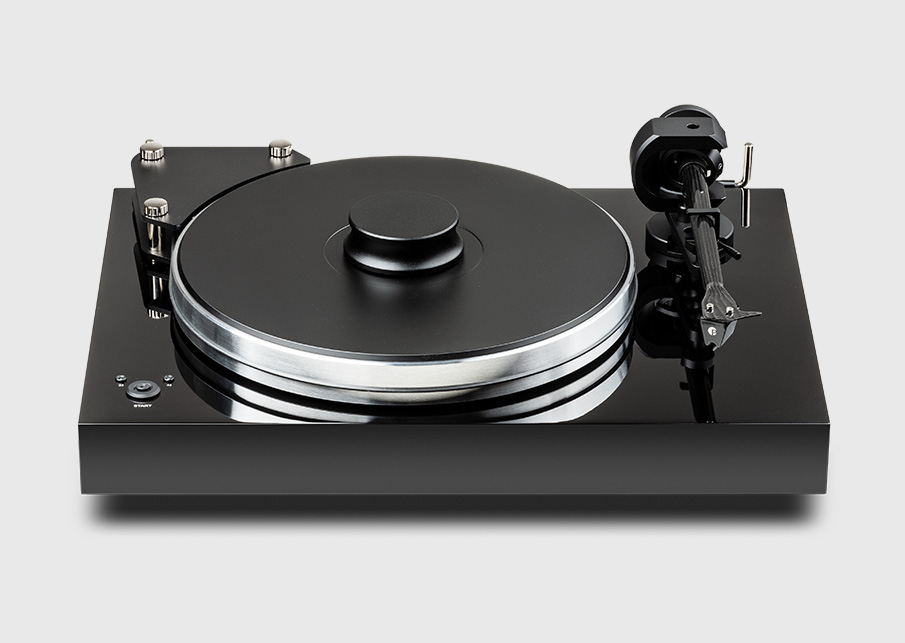
How far this gets taken is clear from figures in our own range: the Gold Note Mediterraneo X weighs 25 kilograms, its platter alone 7 kilograms. The Pro-Ject X8 B comes to 15 kilograms with a 5.1-kilogram aluminium platter machined from a solid billet.
The advantage of this approach is its stubbornness. There is nothing that can drift out of adjustment. No springs to age. Changing cartridge alters nothing. A mass-loaded deck that is set up correctly is still set up correctly ten years later.
The disadvantage lies in the same property. Mass only helps against disturbances it does not move with. Put such a deck on a springy wooden floor and the whole assembly swings as one — and those 25 kilograms then make matters worse, because a floor that sags gives way more readily under load.
Suspension: what is decoupled never hears about it
The opposite approach separates what matters from everything else. Platter, bearing and tonearm sit on a subchassis of their own, hung on springs inside the plinth. Anything arriving from outside has to pass through those springs first.
Springs and mass together form a resonant system with a natural frequency, usually between two and four hertz. Anything well above that is heavily damped — and footfall is well above it. A subchassis therefore acts as a mechanical low-pass filter: it lets through slow movements that bother nobody and blocks the fast ones that would reach the stylus.
The advantage: this works where no amount of weight will. Old buildings, floorboards, a shelf on a wall that moves with the music.
The price is effort. A subchassis has to be levelled and adjusted, and the tuning depends on the weight of what sits on it. Fit a considerably heavier cartridge later and you have changed the suspension and must readjust. Springs and damping elements also age; after many years they become a maintenance item.
The third way, which is now the most common
Between the two camps a compromise has taken over, and it shapes most current decks: the mass stays, but the connection to the surface below is made soft. It is not half the machine that is decoupled, only the contact with the furniture.
The Pro-Ject Xtension 9 Evolution stands on three magnetic feet — the deck carries its weight on a magnetic field rather than on rigid contact. The X8 B and the Debut Reference 10 use TPE-damped feet, an elastomer that converts energy into heat instead of passing it on.
This does not replace a proper subchassis. It does remove a good part of the problem without bringing the setup work with it — and that covers what most living rooms actually demand.
The test that takes ten seconds
Before you think about construction, test your location. Put a record on, lower the stylus, but leave the platter stopped. Turn up to normal listening volume. Then walk across the room as you normally would.
If you can hear your own footsteps through the speakers, the problem is where the deck stands, not the deck. A wall shelf on a load-bearing wall solves that for a fraction of what a new turntable costs.
Turn it down again afterwards before you start the music. For this test the volume control sits higher than you will want it.
What this means for our range
In fairness: every deck we currently stock is a mass-loaded design with damped or decoupled feet. We do not carry a classic sprung-subchassis turntable.
If your floor flexes, the most effective measure is rarely a purchase in any case. It is a wall shelf, a different position, or a decoupling base under the deck you already own. Ask us first rather than buying a heavy turntable and discovering that it never settles where you have put it.
Part 2: The cartridge
The same process, arranged two ways
Both types do the same thing: they generate a voltage by moving a conductor through a magnetic field. The difference is which part moves.
In a moving magnet design a small magnet sits at the end of the cantilever and moves between fixed coils. In a moving coil design it is the other way round: the coils sit on the cantilever and move, while the magnet stays put.
Everything else follows from that one swap.
| MM – moving magnet | MC – moving coil | |
|---|---|---|
| Moving mass | higher – a magnet weighs more than a few turns of wire | lower – the actual technical argument for MC |
| Output voltage | high, because the coils may be as large as you like (our cartridges: 4 mV) | low, because the coils must stay light (ours: 1.8 down to 0.25 mV) |
| Connection | works with virtually any phono input | needs a stage with considerably more gain |
| Loading | 47 kΩ, and cable capacitance matters | loading matched to the cartridge’s internal impedance |
| Stylus | usually user-replaceable | generally not – the maker retips the cartridge |
| Running costs | a replacement stylus assembly | a retipping service, considerably dearer |
What the lower mass actually buys you
Moving mass is the heart of the matter. The lighter the thing that has to follow the groove, the more accurately it follows — particularly on fine, fast deflections, which means the treble and the leading edges of notes. That is why MC designs dominate the higher price brackets, and it is a real reason.
It just gets routinely shortened into a claim that is not true.
The mistake
An MC cartridge is not better because it is an MC cartridge. The low output is a disadvantage you accept in exchange for better tracking, and that disadvantage has to be absorbed by the phono stage.
A 0.25-millivolt cartridge on an input without enough low-noise gain sounds worse than a 4-millivolt MM on the same input. What you hear then is not finer tracking but the hiss of the stage. This is not a theoretical problem — it is the most common bad buy in analogue audio.
Treble: the one difference that really does follow from the principle
An MM cartridge has a high inductance, typically between 400 and 700 millihenries depending on the model. Together with the capacitance of the cable and the input of the stage, this forms a resonant circuit. Depending on that capacitance its resonance lands somewhere between 12 and 20 kilohertz — inside the audible range or just above it.
The result is not an even attenuation but a peak first and a steep fall behind it. Too much capacitance therefore does not sound dull, it sounds hard. That is why manufacturers quote a capacitance range for MM cartridges, and why the same cartridge can sound different on two different cables.
An MC cartridge has an inductance in the microhenry range, four to five orders of magnitude lower. The same resonance therefore ends up in the megahertz region and stops mattering. The treble of an MC does not depend on which cable you use.
This is the one sonic difference that genuinely follows from the generator principle. It is not “MC sounds better up top”, it is: with MM the treble is a matching question, with MC it is not.
And the bass?
You often hear that MM cartridges sound fuller or warmer in the bass. There is no physical basis for it. Both types are velocity transducers and both run through the same RIAA equalisation. The inductance that shapes the treble is irrelevant at the bottom: at 100 hertz, 630 millihenries amount to about 400 ohms of reactance — against a 47-kilohm load that is nothing.
What creates the impression is usually the other direction. If a cartridge has a recessed treble, the balance sounds warmer. The bass is not fuller; the treble is quieter.
The only real low-frequency variable is the resonance formed by cartridge compliance and effective tonearm mass. It should sit between 8 and 12 hertz — above record warp, below the lowest music. That is a question of the arm-and-cartridge combination, not of the generator principle. A very compliant cartridge in a heavy arm drops below that window and becomes unsettled on warped records, whether it is MM or MC.
Old records, dust and clicks: here it is the stylus profile that decides
Anyone with a collection that has been played for decades has a different problem from someone buying new pressings. And the answer is not on the line that says “MM or MC”, but one line further down the spec sheet.
A conical stylus touches the groove wall at two tiny points within a narrow band. A Shibata, line contact or Micro Ridge profile has a much smaller side radius and a long vertical contact line — it sits against different, deeper parts of the wall.
On a record played for decades with conical or elliptical styli, that deeper zone is undamaged. A fine profile reads where nothing has yet been worn away — and on a well-played record it can genuinely be quieter than a simpler stylus. Manufacturers have described this for years; we are not aware of a published measurement, the reasoning is geometric.
The caveat belongs with it: this applies to playing wear. Scratches cut through the entire wall, and dust settles everywhere — a fine profile reaching deeper into the groove is if anything more likely to find debris down there. Fine profiles also demand more careful alignment and clean records. More resolution always means more resolution of the faults as well.
The point that matters: stylus profile has nothing to do with MM or MC. They are two entirely independent design decisions. You can see it directly in our own range: the Gold Note Vasari Shibata is an MM cartridge with 4 millivolts and a Shibata profile. Conversely, several of our MC cartridges carry a micro-elliptical profile. If you are buying because of old records, ask about the profile — not about the generator principle.
The rule of thumb: first what you need, then what you want
What you need – decided by the stage
- A fixed phono input in an integrated amplifier, not switchable: MM. Practically all of these are built for 47 kΩ and MM output levels.
- A phono stage with switchable loading and 60 dB or more: MC. Only here does the better tracking actually pay off.
- In between: a high-output MC. Our Donatello Red delivers 1.8 mV and so asks far less of the stage than a 0.35 mV cartridge would.
- A very quiet MC on a stage that only just copes: a better power supply for the stage often achieves more here than a dearer cartridge.
What you want – decided by your collection
- Mostly new, clean pressings: a fine profile pays off in full here. What it uncovers is music, not wear.
- Mostly old, heavily played records: a fine profile reads parts of the groove earlier styli never touched. Look for Shibata, line contact or Micro Ridge — available as MM and as MC alike.
- Scratched or dirty records: no stylus profile fixes this; a record cleaning machine does. A finer cartridge tends to make such faults clearer, not kinder.
- Treble you do not want turning hard: with MM this is adjustable through capacitance — cable and input together within the range the maker quotes. With MC that adjustment does not exist; the treble is what it is.
- 78s and historical pressings: a separate matter. You need a wider stylus profile and a stage with the appropriate equalisation curves.
Where the two questions meet
Both subjects come down to the fact that a turntable is not a self-contained device. It hangs off the floor below it and off the electronics behind it. It can repair neither by itself, and both decide more about the result than the step up to the next model does.
That produces an order of priorities most people find uncomfortable, because it starts with the dullest item:
A sensible order
- The location. Usually costs nothing and decides the most.
- Deck and tonearm. They set what is possible at all.
- The phono stage. It determines which cartridges are candidates.
- The cartridge. Last, because it follows from the three above.
Most people work through that list backwards. It explains a good share of the disappointments you read about in forums.
Conclusion
Mass or suspension is not a question of quality but of flooring. On a solid surface a heavy deck is uncomplicated and permanently stable. On a floor that moves, decoupling is what helps — at the deck, or better still at the location.
MM or MC is not a question of ambition but, first of all, of phono stage. MC brings finer tracking and a low output voltage as the price. If you have the stage to handle it, you get the benefit. If you do not, you only pay the price.
What comes after that, though, is no longer decided by the generator principle. Exactly one sonic property depends on it: whether the treble depends on cable capacitance or not. Everything else — how finely the groove is tracked, how a well-played record sounds, how much dust you hear — is decided by the stylus profile. And that is entirely independent of MM or MC.
If you are unsure which of these is the limiting factor for you, write and tell us what you have — room, furniture, amplifier, cartridge. It can usually be settled in a few sentences, and it is the cheapest advice available.
Questions about your system?
Send us a message on WhatsApp and we will be happy to help. Or listen for yourself: in our listening room in Bari you can audition selected equipment at your own pace, by appointment.
Related Products
-

![]()
- New
On orderPro-Ject X8 B
€1,999.00High-mass turntable weighing around 15 kilograms, with a 5.1-kilogram aluminium platter and 9cc EVO carbon tonearm – with true balanced output. Available without a cartridge for €1,999 or as a SuperPack with a factory-fitted Ortofon Quintet Blue for €2,299.
-
![]()
- New
On orderPro-Ject Xtension 9 Evolution
€2,990.00Magnetically decoupled feet, EVO 9 CC carbon tonearm and the Pick it DS2 MC cartridge – Pro-Ject’s reference class.
-
- New
-
- New
-
- New
On orderGold Note Donatello Red
€850.00Gold Note MC cartridge, Micro Elliptisch stylus, 1,8 mV output.
-
![]()
- New
On orderGold Note Donatello Gold
€1,090.00Gold Note MC cartridge, Micro Elliptisch stylus, 0,5 mV output.





Founder of Level Audio, trained sound engineer and a hi-fi enthusiast and friend of good sound since a young age.